Introduction
San Diego homeowners who install solar panels often expect immediate, dramatic savings on their SDG&E bills. Then the first few statements arrive, and the numbers don't add up. Credits don't appear as monthly cash refunds, they don't offset every line item on your bill, and the value of your exported solar energy depends on when your system was interconnected.
SDG&E's net metering program is widely discussed but rarely explained end-to-end. Most homeowners grasp the basic concept — "I get credit for extra power" — but don't understand the monthly accrual cycle, the annual True-Up settlement, or the critical differences between what credits can and cannot offset.
Even fewer realize that the net metering landscape changed dramatically in April 2023, creating two different compensation structures depending on when you applied.
This article explains what SDG&E net metering is, how the credit system works step-by-step, what factors affect your credits, and when the program may not be enough on its own to maximize your solar investment.
TL;DR
- SDG&E's net metering program credits solar homeowners for excess electricity exported to the grid
- Credits accumulate monthly within a 12-month billing cycle, not as cash payments
- At year-end, the True-Up bill settles your account—any surplus generation pays out at wholesale rates, not retail
- Credits offset only energy charges—not taxes, minimum fees, or infrastructure costs
- NEM version (2.0 vs. 3.0), system size, and time-of-use rates all determine how much you actually save
What Is SDG&E Net Metering?
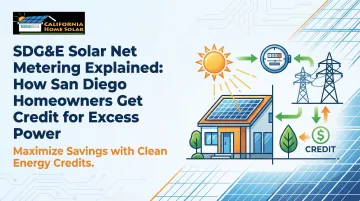
Net energy metering (NEM) is a billing arrangement where SDG&E tracks the difference between electricity your solar system sends to the grid and electricity you pull from it. During sunny afternoons, your panels generate more power than your home uses and the surplus flows to SDG&E's grid. At night or on cloudy days, you draw that power back.
The "net" of those transactions determines your monthly credit or charge.
Net metering is a credit system, not a cash-back program. Credits earned offset future electricity charges within the same 12-month settlement period — you won't see monthly checks. Instead, credits roll forward and reduce what you owe at year-end.
SDG&E currently operates two distinct net metering programs:
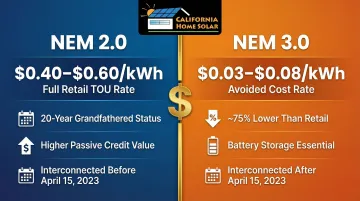
- NEM 2.0: For customers who applied before April 15, 2023. Export credits are valued at full retail time-of-use rates
- NEM 3.0 (Net Billing Tariff): For applications submitted on or after April 15, 2023. Export compensation averages $0.03–$0.08/kWh, compared to retail rates of $0.40–$0.60/kWh
Eligibility basics: You must own a solar (or other renewable) generation system connected to SDG&E's grid, sized to meet—but not substantially exceed—your annual electricity consumption. SDG&E limits system modifications to increases of no more than 10% or 1 kW (whichever is greater) to maintain your original NEM status.
How SDG&E Net Metering Works: From Solar Production to Bill Credit
The net metering process begins the moment your solar panels start generating more electricity than your home can use. That surplus flows out to the SDG&E grid and gets logged as exported energy. At night or on cloudy days, when your panels aren't producing, your home draws from the grid instead — logged as imported energy. The net difference between these two figures determines your monthly credit or balance.
The Bidirectional Meter
SDG&E installs or upgrades to a net meter that separately tracks energy you send to the grid and energy you pull from it. This bidirectional meter drives the credit calculation that appears on your monthly NEM Summary. Readings happen monthly, and the summary shows your net position for that billing period.
What that net position is actually worth depends on which NEM version your system falls under.
Under NEM 2.0, export credits are valued at the full retail time-of-use rate at the time of export—meaning energy exported during 4–9 p.m. peak hours is worth significantly more than midday off-peak exports. Under NEM 3.0, export rates are set at the wholesale "Avoided Cost" rate, averaging 75% lower than retail rates. This shift makes self-consumption and battery storage far more valuable than exporting.
The 12-Month Settlement Structure
SDG&E does not require residential customers to pay their monthly electric balance immediately. Charges and credits accumulate over 12 months until the annual True-Up bill is issued. You may choose to pay monthly but are not required to until settlement. This deferral privilege is unique to the NEM electric account—your gas bill (if you have one) must be paid monthly and is billed separately.
How the Process Works: Production to True-Up
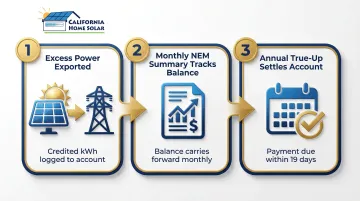
Excess power is exported. During peak sun hours (typically 10 a.m.–3 p.m.), a properly sized solar system often generates more electricity than the home uses. That surplus flows to the SDG&E grid through the bidirectional meter, and the exported kWh are logged for credit calculation.
Monthly NEM Summary tracks the running balance. Each month, SDG&E calculates the difference between kWh exported and kWh imported. Export more than you consume, and a net generation credit carries forward. Consume more than you generate, and a charge accumulates. Either way, payment isn't due until True-Up — both figures just appear on your bill.
Annual True-Up settles everything. At the end of the 12-month period, SDG&E issues the True-Up bill. If cumulative charges exceed credits, you pay the remaining balance within 19 days. If credits exceed charges for the full year, SDG&E compensates you at the Net Surplus Compensation (NSC) rate — currently around $0.028–$0.04/kWh, far below the retail rate you pay for imported energy.
How SDG&E Calculates Your Credits and the Annual True-Up Bill
Here's how SDG&E actually does the math — from monthly credit calculations to the annual True-Up settlement.
Monthly Credit Calculation
SDG&E subtracts total kWh consumed from total kWh generated during the billing month. The surplus kWh is multiplied by the applicable rate to produce a dollar credit. Because energy rates vary by time of day, SDG&E performs this calculation separately for each rate period, then sums the results.
For NEM 2.0 customers: The time-of-use rate at the time of export determines credit value. Export 10 kWh during a summer peak hour at $0.60/kWh? You earn a $6.00 credit.
For NEM 3.0 customers: Export credits are calculated using the Avoided Cost Calculator rate—averaging $0.03-$0.08/kWh—regardless of when you export. The same 10 kWh might earn just $0.50 in credit.
What Credits Can and Cannot Offset
Net generation credits apply only to energy charges on your electric bill. They cannot reduce:
- Minimum daily charge — approximately $0.329/day ($120/year) for residential Schedule DR customers
- Customer charges for infrastructure cost recovery
- Demand charges based on peak power draw (primarily commercial accounts)
- Taxes and public purpose program fees, which are legally separate from energy costs
Even a highly productive solar system will result in some annual True-Up balance due to these non-offsettable charges.
Net Surplus Compensation (NSC) Rate
If you generate more electricity than you consume over the entire 12-month period (net positive kWh for the year), SDG&E pays the surplus at the NSC rate—a rolling wholesale market average currently $0.028–$0.04/kWh. That's roughly 7-10% of the retail rate you pay for grid electricity, so intentionally oversizing your system rarely makes financial sense.
How the True-Up Bill Works in Practice
All those monthly credits and carry-forward balances get settled once a year. The NEM Summary included with your True-Up bill provides a month-by-month accounting of net consumption or net generation, the dollar value of each period, and the final settlement amount.
If you owe a balance: Payment is due within 19 days (residential) or 15 days (commercial).
If you have surplus credits: You can request a check (automatically issued if the value exceeds $100) or leave the credit on your account for the next settlement period.
Gas Billing Separation
Once you enroll in net metering, SDG&E separates gas and electric billing into two distinct accounts with different account numbers and different payment rules. Gas bills must be paid monthly; the electric NEM account can defer payment until True-Up.
Key Factors That Affect Your SDG&E Net Metering Credits
Three primary factors determine how much value you extract from SDG&E's net metering program:
System Sizing
SDG&E requires solar systems to be sized to match annual consumption—not to significantly exceed it. Oversizing does not proportionally increase credits, since surplus generation at year-end is compensated at the low NSC wholesale rate (approximately $0.03/kWh versus $0.40-$0.60/kWh retail).
A properly sized system is the single most important factor in maximizing net metering value. Working with an experienced installer ensures your system is correctly sized for your actual usage profile before interconnection, avoiding the costly mistake of oversizing that delivers minimal financial return.
Time-of-Use (TOU) Rate Structure
SDG&E residential solar customers are placed on time-of-use rate plans. The value of exported energy depends on when it is exported:
Current TOU Periods (Schedule DR):
- On-Peak: 4:00 p.m. – 9:00 p.m. daily (highest rates, most valuable export window for NEM 2.0)
- Off-Peak: 6:00 a.m. – 4:00 p.m.; 9:00 p.m. – Midnight (moderate rates)
- Super-Off-Peak: Midnight – 6:00 a.m. weekdays; extended weekend windows (lowest rates)
The solar misalignment problem: Solar production peaks midday (10 a.m. – 3 p.m.) during Off-Peak or Super-Off-Peak windows. You're exporting large volumes during low-rate periods and buying back energy during expensive On-Peak hours in the evening (4–9 p.m.). How much this hurts your bill depends heavily on which NEM version you're on—covered in the next section.
NEM Version (2.0 vs. 3.0)
NEM 2.0 customers (interconnected before April 15, 2023) receive export credits at the full retail TOU rate, preserving higher credit values. This status is grandfathered for 20 years from the original interconnection date, provided system size doesn't increase by more than 10% or 1 kW.
NEM 3.0 customers (interconnected on or after April 15, 2023) receive much lower export compensation rates. Midday exports that were once profitable now return pennies, which changes the economics considerably:
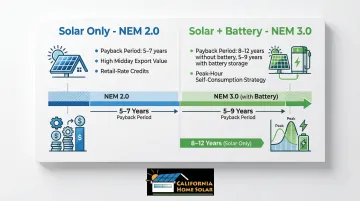
- Solar-only payback periods have stretched from 5–7 years to 8–12 years
- Battery storage can recover 3–5 years of that lost value by enabling peak-hour self-consumption
- Pairing storage with solar is no longer optional for most NEM 3.0 households—it's the strategy
Common Misconceptions About SDG&E Net Metering
Several persistent myths about net metering lead San Diego homeowners to make poor sizing decisions or hold unrealistic expectations about their bills. Here's what the numbers actually show.
Misconception 1: "I'll Get Money Back Every Month"
Net generation credits do not result in monthly cash payments. Credits accumulate on your account and offset charges within the 12-month period. Only at True-Up — and only if you have net surplus generation for the full year — is any compensation issued. That payout comes at the NSC wholesale rate ($0.03–$0.04/kWh), not the retail rate ($0.40–$0.60/kWh) you pay for imported power.
Misconception 2: "Net Metering Eliminates My SDG&E Bill Entirely"
Certain charges are legally not offsettable by net generation credits—including the minimum daily charge ($0.329/day), customer charges, taxes, and public purpose program fees. Even a highly productive solar system will result in an annual True-Up balance of at least $120 due to the minimum daily charge alone, plus any non-bypassable charges on energy pulled from the grid.
Misconception 3: "Bigger System = Bigger Credits"
Oversizing a solar system does not lead to proportionally larger credits. Because SDG&E's NSC wholesale rate is a fraction of the retail rate (approximately 7–10%), exporting large amounts of surplus energy annually is economically inefficient. System sizing should align with your actual annual consumption — that's how you maximize financial return under net metering, not by generating excess power to sell back at wholesale rates.
When Net Metering Alone May Not Maximize Your Solar Savings
Net metering is a powerful tool, but it has limitations—especially under the new NEM 3.0 structure.
The NEM 3.0 Challenge
Customers who interconnected after April 15, 2023 receive substantially lower export rates (averaging $0.03–$0.08/kWh versus retail rates of $0.40–$0.60/kWh). The traditional model of exporting surplus and banking credits at retail value is far less effective under these rules. NEM 3.0 customers benefit far more from self-consumption—using solar energy in real time—and from battery storage that captures midday excess production for use during evening peak hours (4–9 p.m.) when grid electricity costs the most.
Battery storage addresses this in two ways:
- Prevents low-value exports — stored energy is used at home instead of sold back at ~$0.04/kWh, effectively valuing that solar at the retail import rate of ~$0.40/kWh
- Enables peak-hour self-consumption — stored power covers your 4–9 p.m. usage when grid electricity is most expensive
Other Scenarios Where Net Metering Underperforms
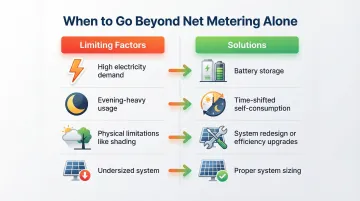
Net metering may not deliver expected savings when:
- High electricity demand — Solar alone cannot adequately offset consumption
- Evening-weighted usage patterns — Consumption heavily concentrated when solar production is zero
- Physical limitations — Shading, poor roof orientation, or local microclimates limit solar output
- Undersized systems — System doesn't generate enough to offset annual consumption
In these cases, pairing solar with battery storage or adding efficiency upgrades—such as energy-efficient HVAC systems, cool roofing, or Low-E windows—makes the biggest difference in reducing your bill.
Conclusion
SDG&E net metering can meaningfully reduce your electricity bills, but the actual savings depend on how well you understand monthly credit accumulation, the annual True-Up settlement, and the limits on what credits can offset. The gap between projected and real savings almost always traces back to three factors: system sizing, time-of-use rate awareness, and which NEM version you're on.
Which version applies to you shapes the entire financial picture:
- NEM 2.0 (interconnected before April 15, 2023) — export credits at full retail rates, stronger passive returns
- NEM 3.0 (interconnected after April 15, 2023) — lower export rates, economics favor self-consumption and battery storage
Knowing which program you're on before signing a solar contract prevents the most common source of unmet savings expectations.
Frequently Asked Questions
What is the difference between NEM 2.0 and NEM 3.0 for SDG&E solar customers?
NEM 2.0 compensates solar exports at the full retail time-of-use rate and is grandfathered for 20 years for customers who interconnected before April 15, 2023. NEM 3.0 (Net Billing Tariff) offers substantially lower export compensation rates averaging $0.03-$0.08/kWh—approximately 75% less than retail—making battery storage far more important for newer installations.
How does the SDG&E annual True-Up bill work?
At the end of each 12-month billing period, SDG&E reconciles all accumulated credits and charges into a single True-Up bill. If charges exceed credits, you pay the balance within 19 days. If generation exceeded consumption for the year, you receive a small surplus payment at the NSC wholesale rate (approximately $0.03-$0.04/kWh).
Can I receive a cash payment for excess solar energy I send to the SDG&E grid?
Monthly credits are not paid out as cash. Only at the annual True-Up—and only if you generated more electricity than you consumed over the full 12 months—will SDG&E issue a payment. That payment is calculated at the Net Surplus Compensation wholesale rate (approximately $0.03–$0.04/kWh), a fraction of what you pay for retail electricity.
What charges on my SDG&E bill cannot be offset by net metering credits?
Net generation credits apply only to energy charges. They cannot offset minimum daily charges ($0.329/day), customer charges, demand charges, taxes, or public purpose program fees—resulting in a minimum annual bill of approximately $120 regardless of how much solar you produce.
How does SDG&E calculate the dollar value of my monthly net generation credit?
SDG&E takes your surplus kWh for the billing month and multiplies it by the applicable export rate—the time-of-use rate for NEM 2.0 customers, or the Avoided Cost rate for NEM 3.0. The resulting dollar credit carries forward to offset future charges within the 12-month settlement period.
Does adding a home battery storage system affect my SDG&E net metering credits?
Battery storage does not eliminate net metering eligibility but changes how you interact with it. Under NEM 3.0, storing excess solar production for use during high-rate evening hours (4-9 p.m.) delivers far more value than exporting it to the grid at lower NEM 3.0 export compensation rates, often cutting system payback periods by 3-5 years compared to solar-only installations.