
Introduction
If your SDG&E bill is running $350–$400 a month, you're not alone. Bundled residential rates have climbed to approximately 45.7 ¢/kWh as of January 2026—roughly 106% higher than the national average of 19 ¢/kWh—and a typical San Diego household consuming 800–900 kWh monthly is paying the price.
Solar has become a direct financial response to these rates, but the economics have shifted. The federal Investment Tax Credit (ITC) expired at the end of 2025 for homeowner purchases, and California's move from NEM 2.0 to net billing (NEM 3.0) has changed how installed systems generate value.
Equipment costs have stabilized, but soft costs—labor, permitting, interconnection—remain elevated in California's regulatory environment.
This guide breaks down what a San Diego solar installation actually costs in 2026—what drives prices up or down, which incentives still apply, and whether the numbers make financial sense under the new economics.
TL;DR
- Average installed cost ranges from $14,700 to $20,000 before incentives for a 6-7 kW system
- Cost per watt typically falls between $2.51 and $3.14/W depending on equipment and installer
- The federal solar tax credit (ITC) covers 30% of installation costs through 2032 under the Inflation Reduction Act
- Payback periods average 7-9 years in San Diego due to SDG&E's extreme rates
- Battery storage is now essential under NEM 3.0 to maximize ROI
Solar Panel Costs in San Diego: 2026 Price Overview
Solar installation costs in San Diego vary significantly based on system size, equipment quality, installer overhead, and site-specific conditions. According to February 2026 data, the market average cost per watt ranges from $2.51/W (EnergySage) to $3.14/W (SolarReviews), with most competitive quotes clustering around $2.70–$2.90/W.
San Diego homeowners typically encounter three general cost tiers:
Entry-level systems ($7,500–$13,000 before incentives):
- System size: 3–5 kW
- Equipment: Standard monocrystalline panels, string inverter
- Best for: Smaller homes, partial offset goals, limited roof space
Mid-range systems ($14,000–$20,000 before incentives):
- System size: 6–8 kW
- Equipment: Quality monocrystalline panels, microinverters or power optimizers
- Best for: Average San Diego homes (1,500–2,500 sq ft), full offset goals
Premium systems ($21,000+ before incentives):
- System size: 9–10+ kW
- Equipment: High-efficiency panels (TOPCon or HJT — advanced panel technologies), battery storage often included
- Large homes or households prioritizing energy independence and backup power during outages
Average Solar Cost by System Size in San Diego
| System Size | Estimated Gross Cost | After 30% Federal ITC |
|---|---|---|
| 4 kW | $10,040–$12,560 | $7,028–$8,792 |
| 5 kW | $12,550–$15,700 | $8,785–$10,990 |
| 6 kW | $15,060–$18,840 | $10,542–$13,188 |
| 7 kW | $17,570–$21,980 | $12,299–$15,386 |
| 8 kW | $20,080–$25,120 | $14,056–$17,584 |
| 10 kW | $25,100–$31,400 | $17,570–$21,980 |
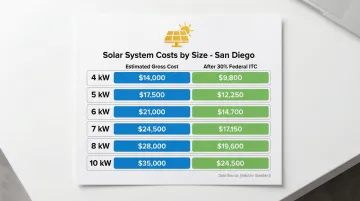
Source: EnergySage and SolarReviews February 2026 data. ITC figures reflect the 30% federal Investment Tax Credit under the Inflation Reduction Act.
These ranges show what you'd pay — but landing in the right row starts with one number: your annual kWh usage from your SDG&E bill. Square footage is a rough proxy at best. A 1,800 sq ft home with heavy AC use may need 8 kW; a 2,200 sq ft home with efficient appliances might only need 6 kW.
Under San Diego's current net billing structure (NEM 3.0), oversizing beyond your actual consumption offers little financial return. Export credits for excess power sent to the grid average just 5–8 ¢/kWh — a fraction of the 45+ ¢/kWh SDG&E charges you to buy it back. The takeaway: size to match your consumption, not exceed it, unless battery storage is part of the plan.
Full Cost Breakdown: What You're Actually Paying For
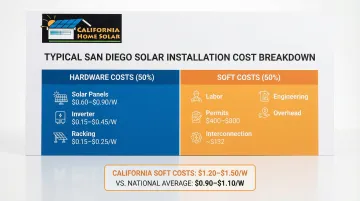
The quoted installation price bundles multiple distinct cost components. Many homeowners are surprised to learn that solar panels themselves represent only about 25-30% of the total system price. In California markets, the split runs roughly 50% hardware costs and 50% soft costs — each category worth understanding before you sign anything.
Solar Hardware Costs
Solar panels are the largest single hardware line item, accounting for roughly $0.60-$0.90 per watt. Brand and efficiency tier drive most of the price difference — budget monocrystalline options from Canadian Solar or Trina cost noticeably less than premium panels from REC or Panasonic.
Inverter choice creates the second major hardware cost variable:
- String inverters: $0.15-$0.25/W, lowest cost but single point of failure
- Microinverters (Enphase IQ8 series): $0.30-$0.45/W, panel-level optimization and monitoring
- Power optimizers (SolarEdge): $0.25-$0.35/W, middle ground between string and micro
Microinverters and optimizers cost more upfront but deliver better output in partial-shade conditions and provide detailed, panel-by-panel performance monitoring.
Racking and mounting hardware adds another $0.15-$0.25/W depending on roof type. Tile roofs require specialized mounting systems that run higher than standard composition shingle installations.
Soft Costs: Labor, Permits, and Interconnection
Hardware is only half the story. Soft costs in California rank among the highest in the nation — driven by permitting complexity, local labor rates, and regulatory requirements. These costs typically include:
- Installation labor (typically 40-50% of soft costs)
- Engineering and design fees
- City/county permit fees ($400-$800 in San Diego)
- SDG&E interconnection application fee (approximately $132)
- Inspection fees
- Project management and overhead
California's soft costs generally run $1.20-$1.50 per watt, compared to the national average of $0.90-$1.10/W.
Roof preparation costs: If your roof needs replacement or reinforcement before installation, this adds a separate cost outside the solar quote. Roof replacement in San Diego runs $8,000-$15,000 depending on size and material. It's worth sorting out any roof issues first — removing and reinstalling panels to fix a failing roof adds significant cost down the road.
Key Factors That Affect Your San Diego Solar Installation Cost
The final price on your solar quote reflects technical, property-specific, and market factors. Knowing what drives each cost puts you in a stronger position when comparing quotes.
System Size and Home Energy Usage
System size is the single largest cost driver. Size your system based on actual annual kWh consumption from your SDG&E bills, not square footage estimates. Pull 12 months of billing data and calculate your average monthly usage.
Critical NEM 3.0 consideration: Under San Diego's current net billing structure, oversizing your system is financially counterproductive. Export credits for excess solar sent to the grid average only 5-8 ¢/kWh—roughly 10-15% of what you pay to buy power from SDG&E. A system sized at 90-100% of your annual consumption maximizes ROI. Going bigger only makes sense if you're adding battery storage to capture that excess generation.
Panel Type and Equipment Quality
Standard monocrystalline panels (19-21% efficiency) from manufacturers like Canadian Solar, Trina, or Jinko cost $0.60-$0.75/W. Premium high-efficiency panels (21-23% efficiency) using TOPCon or HJT technology cost $0.85-$1.10/W but require fewer panels to achieve the same output—valuable if roof space is limited.
Inverter choice is a quality-versus-budget decision with 25-year implications:
- String inverters: lowest cost, but a single failure takes down the whole system
- Microinverters: highest cost, but each panel operates independently — better for shade and easier to troubleshoot
- Power optimizers: middle ground, with panel-level monitoring and a central inverter
Roof Condition, Orientation, and Shading
San Diego's diverse housing stock—from Craftsman bungalows to modern flat-roof homes—means site-specific installation complexity varies significantly.
Roof orientation: South-facing roofs are ideal. West-facing roofs work well under NEM 3.0 because they generate power during expensive 4-9 PM peak hours. North-facing roofs are generally not worth installing on.
Roof pitch and material:
- Composition shingle: Standard installation, lowest cost
- Tile roofs: Require specialized mounting, add $0.15-$0.30/W to labor costs
- Flat roofs: Need ballasted racking systems, moderate cost increase
Shading: Trees, chimneys, or neighboring structures that cast shade require either microinverters/optimizers (to minimize impact) or strategic panel placement. Heavy shade may make solar uneconomical.
Installer Selection and Market Competition
Quotes for identical systems can vary by $3,000-$5,000 between installers in San Diego. A lower quote isn't automatically better—equipment quality, warranty terms, and whether the installer will be around for service over a 25-year system life all matter.
Due diligence checklist:
- Get at least 3 quotes from different installers
- Verify California Contractors State License Board (CSLB) licensing (C-46 Solar or C-10 Electrical)
- Check reviews on Yelp, Google, and Better Business Bureau
- Ask about workmanship warranty duration (separate from manufacturer warranties)
- Confirm who handles permitting and SDG&E interconnection
Longevity matters in this industry. California Home Solar has operated in Southern California for 36 years and holds Top 500 Solar Contractor recognition — the kind of track record that matters when you need warranty service a decade from now.
Solar Incentives That Reduce What You Pay
The gross cost of a San Diego solar system can be reduced by available incentives, but the landscape has changed dramatically in 2026.
Federal Investment Tax Credit (ITC)
CRITICAL UPDATE: The federal Residential Clean Energy Credit (ITC) expired for homeowner purchases after December 31, 2025. Systems installed in 2026 and beyond do not qualify for the federal tax credit that previously offered a 30% reduction in upfront cost.
Impact on economics: A $17,500 system that would have cost roughly $12,250 after the ITC in 2025 now costs the full $17,500 in 2026. Payback periods extend by approximately 2-3 years compared to systems installed before the credit expired.
Lease/PPA exception: The commercial investment tax credit may still apply to systems owned by solar companies (not homeowners) under lease or Power Purchase Agreement (PPA) structures. The value may be passed to homeowners through lower monthly payments, but you forfeit ownership benefits.
California and San Diego-Specific Incentives
With the federal ITC gone, state and local programs carry more weight than ever.
Self-Generation Incentive Program (SGIP)
SGIP provides rebates for battery storage systems paired with solar. In San Diego, this is especially relevant given wildfire risks and Public Safety Power Shutoff (PSPS) events.
Current SGIP incentive levels (2026):
- Equity Budget: Up to $850/kWh for low-income customers
- Equity Resiliency: Up to $1,000/kWh for customers in high fire-threat districts or with medical baseline needs (can cover nearly 100% of battery costs)
- General Market: Often waitlisted or exhausted — check current status at selfgenca.com
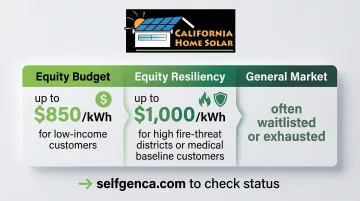
For a typical 13.5 kWh battery (Tesla Powerwall size), Equity Resiliency customers could receive up to $13,500 in rebates, which can cover the battery's full cost when bundled with a solar installation.
Property Tax Exclusion:California's Active Solar Energy System Exclusion prevents the value of your solar system from increasing your property tax assessment. This exclusion is currently valid through January 1, 2027. For a $17,500 system, this saves approximately $175-$200 annually in avoided property tax increases.
No State Income Tax Credit: California does not offer a state income tax credit for residential solar, despite what many homeowners assume.
Net Billing (NEM 3.0) reality:SDG&E's net billing structure is not an incentive. It's a policy that affects your ongoing savings. Systems interconnected after April 14, 2023 receive export credits based on the Avoided Cost Calculator (ACC), which varies by hour and season but averages only 5-8 ¢/kWh. That's roughly 75% lower than the retail-rate credits homeowners received under the old NEM 2.0 policy, making battery storage essential for maximizing ROI.
Is Solar Worth It in San Diego in 2026? ROI and Payback
Despite the loss of the federal ITC and the shift to NEM 3.0, solar remains financially viable in San Diego due to one overwhelming factor: SDG&E's electricity rates are the highest in the nation.
The Rate Advantage
At 45.7 ¢/kWh, every kilowatt-hour your solar system generates displaces a high-cost utility purchase. Compare this to the national average of 19 ¢/kWh—San Diego residents pay 2.4 times more for grid electricity than the typical American household.
Payback period estimates for 2026:
- EnergySage data: 7.41 years average
- SolarReviews data: 8 years with battery, 9 years without
- National average: Approximately 11 years
San Diego's payback periods remain 2-3 years faster than the national average despite losing the federal tax credit, solely because of SDG&E's extreme rates.
25-year savings estimates: $104,000-$109,000 over the system's lifespan, assuming utility rates continue rising at historical rates (3-5% annually).
The NEM 3.0 Reality: Battery Storage Is Now Essential
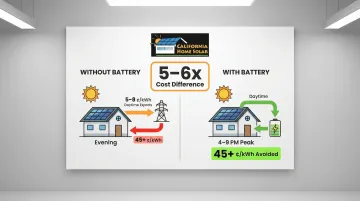
Under California's net billing structure (NEM 3.0), the economics favor self-consumption over grid export. Export credits average 5-8 ¢/kWh, while SDG&E charges 45+ ¢/kWh during peak hours (4-9 PM). This 5-6x difference makes battery storage the key to maximizing savings.
How battery storage changes the math:
- Without battery: Excess solar generated during the day exports to the grid at 5-8 ¢/kWh credit, then you buy power back at 45+ ¢/kWh in the evening
- With battery: Excess solar charges your battery, which discharges during expensive 4-9 PM peak hours, avoiding 45+ ¢/kWh purchases
Battery cost and incentives:Adding a battery in California costs approximately $15,600 before incentives. SGIP rebates can offset $850-$1,000 per kWh of capacity—potentially covering $11,500-$13,500 of the cost for eligible homeowners in high fire-threat areas.
Beyond pure economics:Battery storage provides backup power during SDG&E outages and PSPS events—increasingly common in San Diego's wildfire-prone areas. This reliability benefit has real value beyond ROI calculations.
Getting an Accurate, Site-Specific Quote
Regional averages are useful for benchmarking, but your actual costs and savings depend on your SDG&E usage patterns, roof conditions, and current incentive eligibility. A contractor familiar with NEM 3.0 paperwork, SGIP rebate processing, and SDG&E's interconnection requirements can make a meaningful difference in both your final cost and how quickly your system goes live.
California Home Solar has worked in Southern California for 36 years and holds Top 500 Solar Contractor recognition. They build quotes around your actual consumption data, roof orientation, and shading conditions—and handle permitting and utility approvals alongside installation.
Frequently Asked Questions
How much does it cost to install solar in San Diego?
The typical installed cost in San Diego ranges from approximately $14,700 to $20,000 before incentives for a 6-7 kW system, with cost per watt averaging $2.51-$3.14/W. Your actual cost depends on system size, equipment quality, roof complexity, and installer selection.
How much will solar cost in 2026?
Solar prices in San Diego in 2026 reflect continued hardware cost declines offset by higher soft costs (labor, permitting). The market average hovers around $2.70-$2.90/W for competitive quotes, holding relatively stable year-over-year.
Is solar worth it in California in 2026?
Yes, solar remains financially worthwhile in California, especially in San Diego given SDG&E's rates of 45.7 ¢/kWh. However, NEM 3.0 has shifted the economics toward self-consumption and battery pairing rather than relying on grid export credits. Payback periods of 7-9 years are still faster than the national average, and 25-year savings exceed $100,000 for typical systems.
How much does solar cost per watt in California?
The California statewide average cost per watt in 2026 is approximately $2.80-$3.20/W. San Diego falls at or slightly above the state average ($2.51-$3.14/W) due to local labor rates and permitting costs. Competitive quotes in San Diego typically cluster around $2.70-$2.90/W.
How much is 1 kWh in San Diego?
SDG&E's bundled residential rate is approximately 45.7 ¢/kWh as of January 2026—among the highest in the United States and roughly 106% higher than the national average of 19 ¢/kWh. This rate gap is the primary reason solar delivers strong ROI in San Diego even as incentive structures continue to evolve.
Why is my SDG&E bill so high when I have solar?
Under NEM 3.0 (net billing), SDG&E's fixed Base Services Charge (approximately $24/month) applies regardless of solar generation and cannot be offset by solar credits. Excess power exported to the grid earns only 5-8 ¢/kWh, while electricity consumed at night or peak hours costs 45+ ¢/kWh. Battery storage significantly reduces those evening purchases and lowers your overall bill.