Introduction
California homeowners face a fundamentally different energy landscape in 2026. Since NEM 3.0 took effect in April 2023, solar export compensation has dropped approximately 75%, making battery storage essential rather than optional for maximizing solar ROI.
Southern California Edison (SCE) and San Diego Gas & Electric (SDG&E) time-of-use rates now spike to $0.59–$0.67/kWh during evening peak hours. Every kilowatt-hour you export to the grid instead of storing costs you real money.
Then there's the wildfire reality: SCE recorded four major Public Safety Power Shutoff (PSPS) events in 2024 alone. For Southern California homeowners, battery backup isn't just about savings—it's about keeping the lights on when the grid goes dark during fire season.
Tesla Powerwall 3 and Enphase IQ Battery dominate the residential storage market in Los Angeles, the Inland Empire, and San Fernando Valley. The wrong choice can cost you thousands in lost savings or leave you without power when you need it most. This guide compares both systems across cost, backup capacity, compatibility, and real-world performance so you can choose with confidence.
TLDR
- Tesla Powerwall 3 delivers 11.5 kW continuous power and 97.5% efficiency, making it the stronger pick for new solar installs and whole-home PSPS backup
- Enphase IQ Battery 10C offers a 15-year warranty and 140°F heat tolerance versus Tesla's 122°F limit, a real advantage in Inland Empire and high-desert climates
- Both qualify for the 30% federal ITC; California SGIP rebates add up to $1,100/kWh on top
- Under NEM 3.0, time-of-use optimization is where both batteries deliver maximum value
- New solar installs favor Powerwall 3; retrofits and hot inland zip codes often favor the Enphase IQ 10C
Tesla Powerwall 3 vs. Enphase IQ Battery: Quick Comparison
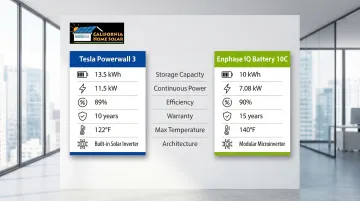
| Feature | Tesla Powerwall 3 | Enphase IQ Battery 10C | Enphase IQ Battery 5P |
|---|---|---|---|
| Usable Capacity | 13.5 kWh | 10.0 kWh | 5.0 kWh |
| Continuous Power | 11.5 kW | 7.08 kW | 3.84 kW |
| Round-Trip Efficiency | 89% (solar-to-home) | 90% | 90% |
| Battery Chemistry | High-voltage lithium | LFP (Lithium Iron Phosphate) | LFP |
| Warranty | 10 years | 15 years / 6,000 cycles | 15 years / 6,000 cycles |
| Operating Temp Range | -4°F to 122°F | -4°F to 131°F | -4°F to 131°F |
California Costs, Incentives & Compatibility
| Feature | Tesla Powerwall 3 | Enphase IQ Battery 10C | Enphase IQ Battery 5P |
|---|---|---|---|
| Est. Installed Cost (LA) | ~$15,228 before incentives | ~$13,000 before incentives | ~$5,155 (per 5 kWh unit) |
| After 30% Federal ITC | ~$10,660 | ~$9,100 | ~$3,609 |
| SGIP Eligibility | Yes (equity: $1,100/kWh) | Yes (equity: $1,100/kWh) | Yes (equity: $1,100/kWh) |
| Integrated Solar Inverter | Yes (6 MPPT, 20 kW max) | No (requires separate) | No (requires IQ System Controller) |
| Retrofit Compatibility | AC-coupled to any system | Best with Enphase microinverters | Best with Enphase microinverters |
The Powerwall 3 includes a built-in solar inverter, which can reduce total system cost by eliminating a separate inverter purchase — a real advantage for new installations in Southern California. Enphase batteries work with any solar system via AC coupling, but pair most cleanly with existing Enphase microinverter setups. If you're retrofitting an older system under NEM 3.0, compatibility with your current inverter brand is often the deciding factor.
Tesla Powerwall 3: What California Homeowners Should Know
Tesla's Powerwall 3, released in 2024, is a fully integrated solar-and-storage system featuring a built-in 11.5 kW solar inverter with six MPPT inputs. For California homeowners installing solar for the first time, this eliminates the need for a separate inverter, reducing both cost and installation complexity.
Standout Power Output for PSPS Events
The 11.5 kW continuous output (11,500 VA) is the Powerwall 3's defining advantage for California PSPS scenarios. This output can simultaneously run:
- Central air conditioning (3-5 kW)
- EV charger at reduced rate (3-7 kW)
- Refrigerator, lights, electronics (1-2 kW)
- Well pump or pool equipment (1-2 kW)
During multi-day grid shutoffs in wildfire season, this whole-home capability keeps your household running normally, not just on backup mode.
Storm Watch: Automatic PSPS Preparation
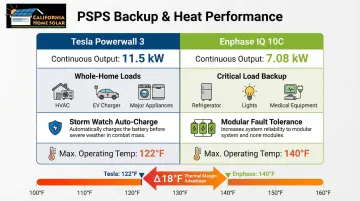
Before high-wind events trigger PSPS shutoffs, Storm Watch has already acted. The feature monitors National Weather Service alerts and automatically charges the battery to 100%, so Southern California homeowners in SCE and SDG&E territory don't need to intervene manually.
TOU Optimization Under NEM 3.0
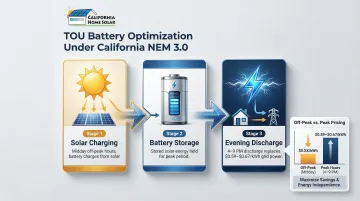
Under California's net billing tariff, the value of exporting solar to the grid has dropped 75%. The Powerwall 3's Time-Based Control software addresses this by:
- Charging from solar during peak production hours (when export rates are lowest)
- Discharging during evening peak windows (4-9 PM under SCE TOU-D-PRIME rates)
- Automatically adjusting based on your utility rate schedule
With SCE evening peak rates at $0.59/kWh and SDG&E at $0.67/kWh, a single full discharge cycle offsets roughly $8–$11 in grid purchases — every day during peak season.
Pricing and Scalability
A single Powerwall 3 costs approximately $15,228 installed in the Los Angeles area before incentives. Incentives can bring that down significantly:
- 30% federal ITC: reduces cost to roughly $10,660
- SGIP equity rebate (high fire threat districts or income-qualifying): up to $1,100/kWh, potentially lowering net cost to $6,000–$7,000
For larger homes or higher energy needs, up to four Powerwall 3 units can be stacked, scaling total capacity to 54 kWh.
Enphase IQ Battery: What California Homeowners Should Know
Enphase offers two battery options for California homes: the IQ Battery 5P (5 kWh, 3.84 kW continuous) as the entry-level modular option, and the IQ Battery 10C (10 kWh, 7.08 kW continuous) as the fourth-generation flagship that addresses capacity concerns while maintaining modularity.
Heat Tolerance: A Southern California Advantage
The 140°F operating temperature threshold versus Tesla's 122°F ceiling matters in Southern California's inland valleys. Summer temperatures in the San Fernando Valley, Inland Empire, and Antelope Valley regularly exceed 110°F. Battery enclosures in exposed locations—south-facing exterior walls, unconditioned garages—can reach ambient temperatures well above rated specs.
Enphase's 140°F ceiling provides an 18-degree safety margin compared to Tesla. When batteries operate above their rated temperature, efficiency drops and warranty protection may be compromised. For homes in Riverside, Palmdale, or Burbank, this thermal headroom is a genuine differentiation factor.
Microinverter Architecture: Modular Reliability
Each Enphase battery unit contains multiple built-in IQ microinverters. If one component fails, the rest of the system continues operating—a reliability advantage during long PSPS outages. The IQ 10C has built-in neutral-forming capability, eliminating the need for a separate IQ System Controller (a separate hub device). The 5P requires that controller for backup functionality.
Scalability is equally straightforward: each additional 10C unit adds 10 kWh of storage and 7.08 kW of continuous power.
15-Year Warranty and LFP Chemistry
Enphase batteries use lithium iron phosphate (LFP) chemistry, which is inherently more thermally stable than cobalt-based chemistries—no thermal runaway risk. The 15-year warranty is 50% longer than Tesla's 10-year coverage, providing more protection over the battery's useful life.
Pricing and Scalability
Here's how the incentive stack breaks down for the Los Angeles market:
| Model | Installed Cost | After 30% ITC | After SGIP Equity Rebate |
|---|---|---|---|
| IQ Battery 10C (10 kWh) | ~$13,000 | ~$9,100 | ~$4,000–$5,000 |
| IQ Battery 5P (5 kWh) | ~$5,155 | ~$3,609 | Varies by income tier |
The 5P costs more per kWh than the 10C, but it lets homeowners start small and add capacity over time. Enphase systems can scale up to 80 kWh total—practical for homes adding EVs or building toward full energy independence.
Head-to-Head: Which Battery Performs Better for California Homes?
California-Specific Cost Comparison
For equivalent storage capacity (~13-15 kWh), here's how the costs compare in the LA market after incentives:
Tesla Powerwall 3 (13.5 kWh):
- Installed cost: $15,228
- After 30% ITC: $10,660
- After SGIP equity rebate ($1,100/kWh × 13.5 kWh = $14,850): Net cost could be negative (SGIP rebate exceeds system cost)
- Effective cost per kWh: $790/kWh before SGIP
Enphase IQ Battery 10C + 5P (15 kWh total):
- Installed cost: $13,000 + $5,155 = $18,155
- After 30% ITC: $12,709
- After SGIP equity rebate ($1,100/kWh × 15 kWh = $16,500): Net cost could be negative
- Effective cost per kWh: $847/kWh before SGIP
Note: SGIP rebates vary by utility territory, customer eligibility, and current program funding. SCE customers in high fire threat districts may receive higher priority. Contact California Home Solar at 877-903-1012 to verify current SGIP step pricing and waitlist status for your specific location.
NEM 3.0 and TOU Savings Potential
California's net billing tariff, effective April 2023, reduced export compensation by approximately 75% compared to NEM 2.0. Under NEM 3.0, the value of exporting solar to the grid is lowest during midday solar abundance and highest during late summer evenings—making it essential to consume as much solar as possible on-site.
Battery storage is now the primary mechanism for maximizing solar ROI under this structure.
Tesla's Time-Based Control:
- Automatically charges from solar during off-peak hours
- Discharges during peak pricing windows (4-9 PM)
- Requires manual setup of utility rate plan in Tesla app
- Uses continuous energy forecasting with seasonal patterns
Enphase's Savings Mode (AI Optimization):
- Forecasts solar production and home consumption
- Minimizes grid imports during peak pricing
- Requires entering static TOU rate details
- Available specifically for California homeowners
Tesla handles rate optimization with less setup; Enphase gives you more manual control. Either way, how well the battery captures peak-hour arbitrage directly determines how quickly it pays for itself — which brings up the question of what happens when the grid goes down entirely.
PSPS Backup and Heat Performance
Backup Power During Multi-Day Outages:
Tesla's 11.5 kW continuous output supports whole-home loads including HVAC, making it appropriate for:
- Larger homes (2,500+ sq ft)
- Homes with central air conditioning
- Households with EV chargers
- Properties with well pumps or pool equipment
Enphase's 7.08 kW (10C) or 3.84 kW (5P) continuous output is better suited for critical load backup:
- Smaller homes (under 2,000 sq ft)
- Essential circuits only (refrigerator, lights, internet, medical equipment)
- Homes without central HVAC or with mini-splits
Heat Performance:
In Southern California's extreme summer heat, battery enclosures in unconditioned garages or on south-facing walls can reach temperatures well above rated specs. Tesla's 122°F operating ceiling means performance may derate above 104°F. Enphase's 140°F ceiling gives you 18°F more headroom — a real advantage for installations in:
- Unconditioned garages in Riverside, San Bernardino, or Palmdale
- South-facing exterior walls in the San Fernando Valley
- Any location where summer temperatures regularly exceed 110°F
For exposed installations in hotter microclimates, Enphase's higher temperature tolerance reduces the risk of efficiency loss or warranty complications.
Which Battery Is Right for Your California Home?
Tesla Powerwall 3 Is the Better Fit If You:
- Are installing new solar (integrated inverter saves cost)
- Need whole-home backup power during PSPS events
- Have high continuous loads (central HVAC, EV charger, pool pump)
- Want the lowest cost per kWh of storage
- Prioritize maximum backup power and efficiency
Enphase IQ Battery 10C or 5P Is the Better Fit If You:
- Have an existing Enphase microinverter system
- Live in high-heat areas (Inland Empire, Antelope Valley, San Fernando Valley)
- Need modular scalability to grow your system over time
- Value a longer 15-year warranty
- Prefer LFP chemistry for thermal stability
Retrofitting an Existing Solar System?
Homeowners with non-Enphase solar systems — string inverters or other brands — can pair either battery with their existing setup. Tesla's AC-coupling works with any inverter, and its lower cost per kWh makes it the more economical retrofit choice for homes without Enphase microinverters.
Not sure which battery fits your home? California Home Solar can assess your load profile, utility rate plan, and SGIP eligibility to point you in the right direction. With 36 years of installations across Southern California, they've seen every scenario. Call 877-903-1012 or email info@cahomesolar.com for a free consultation.
Conclusion
The right choice comes down to your situation:
- Tesla Powerwall 3 — best for new solar installs, whole-home PSPS protection, and homeowners who want maximum power output at a lower per-kWh cost
- Enphase IQ Battery 10C — best for existing Enphase systems, high-heat microclimates, and anyone who needs modular expansion with longer warranty coverage
Under NEM 3.0, the right battery isn't just backup insurance—it's the primary tool for maximizing your solar investment. Shifting more consumption to your stored solar—instead of buying peak-rate grid power—is now the core strategy for reducing bills. Both batteries do that well. What differs is how each fits your roof, your utility rate structure, and how much backup capacity you actually need during wildfire season.
If you're still weighing options, the team at CA Home Solar has installed both systems across Los Angeles County and can walk you through which configuration makes sense for your home.
Frequently Asked Questions
Is Enphase more expensive than Tesla?
Enphase IQ Battery systems typically cost more per kWh of storage than the Tesla Powerwall 3. However, SGIP rebates and the longer 15-year warranty can narrow the real-world cost gap for California homeowners. The IQ 10C is more cost-competitive than older 5P-only configurations.
Is Enphase or Tesla Powerwall better?
Neither is universally better. Tesla leads on power output, efficiency, and cost per kWh; Enphase leads on modularity, warranty length, heat tolerance, and compatibility with existing Enphase microinverter systems. The right choice comes down to your home's setup and priorities.
What is the difference between Tesla Powerwall 3 and Enphase 10C?
The Powerwall 3 has higher capacity (13.5 kWh vs 10 kWh), higher continuous power (11.5 kW vs 7.08 kW), and includes an integrated solar inverter. The IQ 10C offers a longer 15-year warranty, higher heat tolerance (140°F vs 122°F), and modular scalability.
Is a solar battery worth it in California?
Under NEM 3.0, a battery is worth it for most California homeowners. It lets you use solar-generated power during expensive evening peak hours instead of buying from the grid. You also get backup during PSPS outages, plus the 30% federal ITC and SGIP rebates cut upfront cost considerably.
Which solar battery brand is best?
Tesla and Enphase are the two leading brands for California residential installations, both with proven track records and strong warranties. If you already have Enphase microinverters or need scalable storage, Enphase fits better. For new installs prioritizing capacity and lower cost per kWh, Tesla is the stronger starting point.