Introduction
Los Angeles is in the middle of a solar boom—but not all solar companies will be around when you need them. Over 100 solar installers have closed or filed for bankruptcy since 2023, leaving thousands of homeowners with orphaned systems and unenforceable warranties. In August 2024 alone, industry giant SunPower filed for Chapter 11 bankruptcy, creating chaos for customers who thought they'd chosen a safe bet.
A solar installation is a 20–25-year commitment affecting your electric bills, home value, and roof integrity. Choose wrong, and you risk voided warranties, poor installation quality, and no one to call when something goes wrong.
Hundreds of solar companies operate across LA, and many are unlicensed or financially shaky. Vetting your contractor before you sign is not optional.
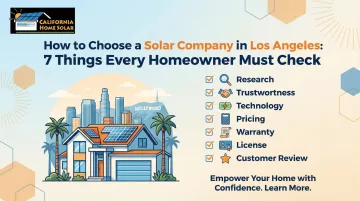
This guide walks you through 7 research-backed checks every Los Angeles homeowner must complete before signing a solar contract — covering licensing, financial stability, warranty terms, and more. Use them as your checklist before you commit.
TL;DR
- Verify the contractor holds a California CSLB C-46 or C-10 license before any conversation goes further
- Prioritize companies with 10+ years of local LA experience — longer track records mean more reliable warranty backing
- Ask specifically about panel warranties, workmanship coverage, and who manages LADWP or SCE permits
- Understand each financing option (loan, lease, PPA, HERO) before comparing quotes, since the structure changes your long-term savings
- Get at least 3 written quotes and watch for red flags like high-pressure tactics or vague contracts
Why Your Solar Company Choice in Los Angeles Matters More Than You Think
The California solar market has shed approximately 17,000 jobs since 2023, driven by high interest rates and the implementation of NEM 3.0. Over 100 solar companies have closed or filed for bankruptcy in this period, including major players like SunPower, ADT Solar, and Sunworks.
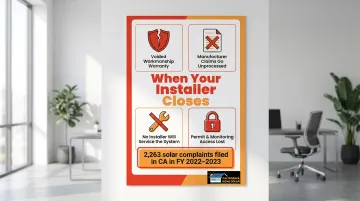
When your installer folds, the fallout is immediate and personal:
- Labor warranties covering roof penetrations, system design, and installation quality die with the company — unenforceable from day one of closure
- Panel and inverter manufacturer warranties stay technically valid, but getting claims processed without the original installer on file is a fight most homeowners lose
- Most other installers won't service a system they didn't install — liability concerns push that work back to you, out of pocket
- Permit records, system documentation, and monitoring access often go dark with no clear path to recovery
Between July 2022 and June 2023, the California Contractors State License Board received 2,263 solar-related complaints, with 54% related to workmanship issues or project abandonment. Knowing what to look for before you sign protects you from becoming one of those complaints — and from being stranded mid-warranty when something goes wrong.
The 7 Things Every LA Homeowner Must Check Before Hiring a Solar Company
These are non-negotiable. Every solar company you consider must pass all seven checks before you sign anything.
Check #1: Valid California Contractor License (C-46 or C-10)
California law requires solar installers to hold a Contractors State License Board (CSLB) license. Hiring an unlicensed contractor is illegal, voids permits, and puts you at legal and financial risk.
Required license classifications:
- C-46 (Solar Contractor) — authorized to install, modify, and repair solar energy systems
- C-10 (Electrical Contractor) — authorized to install electrical wiring and solar photovoltaic systems
- B (General Building Contractor) — authorized only if the project involves two or more unrelated trades (e.g., solar plus roofing)
How to verify a license:
- Go to cslb.ca.gov
- Search by company name or license number
- Confirm the license is active and in good standing
- Check for any complaints or disciplinary actions
In FY 2022-2023, the CSLB secured $6.3 million in restitution for consumers harmed by unlicensed or negligent solar contractors. Don't skip this step.
Check #2: Proven Local Track Record (10+ Years in Business)
Longevity matters. A company with a decade or more of LA installations has survived market downturns, navigated utility rule changes like NEM 3.0, and has a verifiable history of customer outcomes.
Why 10+ years specifically:
- Wood Mackenzie predicted the California residential solar market would be cut in half by 2024 due to NEM 3.0
- California recorded its lowest quarterly residential solar capacity additions since Q3 2020 in early 2025
- Companies that survived the 2023-2024 shakeout have proven financial stability
How to verify track record:
- Check Google reviews, Yelp, and BBB for LA-area reviews specifically
- Look at review volume and recency (50+ recent reviews is a good sign)
- Ask the company: "How many installations have you completed in Los Angeles County?"
- Request references from customers whose systems are 5+ years old
A company with deep LA roots understands LADWP vs. SCE permit processes, knows local building codes, and will likely still be operating when you need warranty service in 2035.
Check #3: Transparent Workmanship & Equipment Warranties
You should receive three distinct warranties in writing before installation begins:
1. Panel manufacturer product warranty
- Covers defects in materials and workmanship
- Standard: 10–12 years
- Anything less is a red flag
2. Panel performance warranty
- Guarantees minimum power output over time
- Standard: 25 years (typically guaranteeing 80-90% output at year 25)
- Premium panels like Maxeon guarantee 88.3% output at year 40
3. Installer workmanship warranty
- Covers labor, roof penetrations, system design, and installation quality
- Standard: 10–25 years
- Only as good as the company standing behind it
Critical question to ask: "What happens to my workmanship warranty if your company closes?"
Look for companies offering third-party warranty insurance (like Solar Insure) that covers parts, labor, and monitoring even if the original installer ceases operations. This is your safety net in an unstable market.
Check #4: Panel Brand Quality and Equipment Specifications
Not all solar panels are equal. Efficiency ratings, temperature coefficients, and degradation rates vary significantly by brand.
What to look for in LA's climate:
- Efficiency: 20–22% for standard panels; 22–24% for premium
- Degradation rate: 0.4% per year (standard); 0.25% per year (premium)
- Temperature coefficient: Lower is better in hot LA summers
Reputable Tier-1 manufacturers:
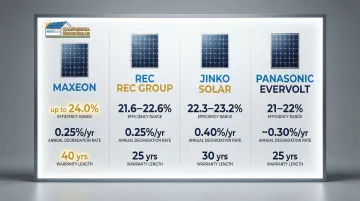
| Brand | Efficiency Range | Degradation | Warranty |
|---|---|---|---|
| Maxeon (SunPower) | Up to 24.0% | 0.25%/year | 40 years |
| REC Group | 21.6–22.6% | 0.25%/year | 25 years |
| Jinko Solar | 22.3–23.2% | 0.40%/year | 30 years performance |
| Panasonic EVERVOLT | 21–22% | ~0.30%/year | 25 years |
Red flag: A salesperson who can't name the specific panel brand and model being proposed, or who gives vague answers like "quality panels" without providing a spec sheet.
What to ask:
- "Which brand and model panels are you proposing?"
- "Can I see the spec sheet?"
- "What's the efficiency rating and annual degradation rate?"
Compare the specs to industry benchmarks. Don't settle for outdated or low-efficiency panels just because they're cheaper.
Check #5: Permit Handling and Utility Interconnection Experience
In Los Angeles, solar installations require permits from the local jurisdiction AND interconnection approval from your utility—LADWP for City of LA, SCE for most of the surrounding county.
What a professional company handles:
- Pulling all building permits with LA Department of Building and Safety (LADBS)
- Submitting interconnection applications to LADWP or SCE
- Scheduling all required inspections
- Securing final Permission to Operate (PTO) from the utility
You should never be asked to pull your own permits. This is a major red flag indicating an unlicensed or inexperienced contractor.
NEM 3.0 considerations:
Under California's Net Billing Tariff (NEM 3.0), which took effect April 15, 2023, export compensation for excess energy is lower than under previous rules. A contractor with deep LA experience understands how to:
- Size your system to maximize self-consumption
- Design around the 9-year export rate lock-in period
- Navigate the Avoided Cost Calculator (ACC) values
Questions to ask:
- "Do you handle all permit pulling and utility interconnection on my behalf?"
- "How many LADWP/SCE interconnections have you completed under NEM 3.0?"
- "What's your typical timeline from contract to Permission to Operate?"
Check #6: Financing Options and Fee Transparency
How you pay for solar affects your return on investment and tax credit eligibility.
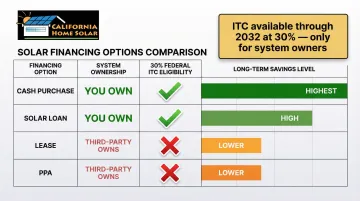
Four main financing paths:
| Option | Ownership | 30% Federal ITC | Long-term Savings |
|---|---|---|---|
| Cash purchase | You own | ✅ You claim it | Highest |
| Solar loan | You own | ✅ You claim it | High |
| Lease | Third-party owns | ❌ Lessor claims it | Lower |
| PPA | Third-party owns | ❌ PPA provider claims it | Lower |
Critical: The 30% federal Investment Tax Credit (ITC) is available only to homeowners who own their system. Under the Inflation Reduction Act, the 30% rate holds through 2032, then steps down to 26% in 2033 and 22% in 2034 before expiring for residential installs in 2035. Owning your system — not leasing — is what qualifies you.
HERO and PACE financing:
The HERO (Home Energy Renovation Opportunity) program was discontinued in 2019 following settlements regarding deceptive practices. Los Angeles County ended its PACE program in May 2020 due to consumer protection concerns. If a contractor references HERO or PACE, verify the current status of any financing program offered — PACE-type products have historically been linked to high costs and liens that complicate home sales.
What to demand in writing:
- Full cost breakdown (equipment, labor, permits, interconnection fees)
- Escalation clauses in leases/PPAs (how much rates increase annually)
- Prepayment penalties
- What happens to the system if you sell your home
- All "dealer fees" (hidden finance charges) disclosed upfront
California law (SB 784) requires explicit disclosure of dealer fees and standardized bill savings estimates. A trustworthy company provides all of this without pressure.
Check #7: Post-Installation Support and System Monitoring
A good solar company doesn't disappear after install day.
What to expect:
- A monitoring platform (Enphase Enlighten or SolarEdge) with live output data for each panel
- Automatic alerts when system production drops unexpectedly
- A direct service contact — not a generic 800 number that routes to a call center
- Optional service contracts for scheduled maintenance over the system's life
Critical questions to ask:
- "Who do I call if my system stops producing?"
- "Do you offer ongoing service contracts?"
- "What monitoring platform do you use, and will I have access?"
- "Do you provide 24/7 monitoring with proactive alerts?"
Companies that deflect these questions or outsource all post-install service to third parties are a genuine risk across your system's 25-year lifespan. Ask specifically who handles service calls — and get the answer in writing.
Red Flags That Signal a Bad Solar Company in Los Angeles
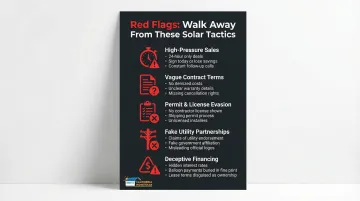
Los Angeles has one of the most competitive solar markets in the country — which means more bad actors alongside the good ones. Walk away immediately if you encounter any of these:
Pressure to sign immediately:
- Unsolicited door-to-door sales with "today-only" pricing
- Demands for immediate signature on electronic tablets
- Claims that "this is the last day to lock in this rate"
Vague or unverifiable contract terms:
- Refusal to provide a written quote before signing
- Unclear system size or equipment specifications
- Generic warranty language without specific terms
- Escalation clauses buried in fine print
Permit and licensing evasion:
- Unwilling to provide CSLB license number upfront
- Asking you to sign before permits are pulled
- Suggesting you can pull your own permits to "save money"
Fake utility partnerships:
- Claiming to be "utility-approved" or "sent by LADWP/SCE" — both utilities explicitly state they don't endorse specific contractors
- Anyone claiming to be "from the utility" is misrepresenting themselves
Deceptive financing:
- Promising "free solar" (nothing is free—someone pays)
- Pushing PACE financing without clear disclosure of risks
- Hiding dealer fees or finance charges
- Refusing to explain how different financing affects ITC eligibility
The FTC and California Attorney General settled with Ygrene Energy Fund for $3 million in 2022 for deceiving consumers about PACE financing. If a company you're evaluating uses any of these tactics, stop the conversation — there are dozens of licensed, reputable installers in Los Angeles who don't need to pressure anyone.
Why California Home Solar Checks All the Boxes for LA Homeowners
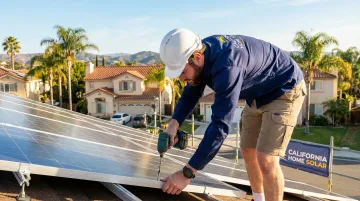
California Home Solar is a Sherman Oaks-based contractor with 36 years of experience serving Los Angeles County—one of the longest-standing solar companies in the region. Solar Power World ranked them a Top 500 Solar Contractor in 2015, 2016, and 2021.
How they map to the 7-check framework:
- Licensed and bonded — CSLB license active and in good standing
- 36 years in business, through multiple market cycles and policy changes
- HERO Registered Contractor — Multiple financing options with transparent terms
- Handles all permits and interconnection across both LADWP and SCE territories in LA County
- 5-Star Yelp rating — Backed by hundreds of positive reviews from local customers
- Enphase and SolarEdge monitoring platforms with 24/7 system visibility
- Roofing, HVAC, and window upgrades available alongside solar—no need to coordinate separate contractors
Every item on that checklist has a practical answer here. California Home Solar manages permits, utility approvals, installation, and post-installation support in-house. Each project gets a dedicated manager, and their Sherman Oaks office at 15335 Morrison St suite #3034 keeps them firmly rooted in the community they serve.
Call 877-903-1012 to schedule a consultation and run through your own checklist with their team.
Conclusion
In a market as crowded and volatile as Los Angeles, the right solar company isn't the one with the flashiest ad or the most aggressive salesperson. It's the one that can verify its license, demonstrate local longevity, explain its warranties clearly, and support your system for its full 25-year life.
Use the 7-check framework as a vetting checklist when getting quotes. Verify the CSLB license. Demand written warranties. Ask about post-installation support. Compare at least three written quotes that break down equipment, financing, and long-term costs.
The time you spend vetting a contractor upfront protects your investment for decades. Companies like California Home Solar — licensed, bonded, and operating in Southern California for 36 years — are exactly what this checklist is designed to help you find. Don't rush, don't sign under pressure, and never hire an unlicensed contractor.
Frequently Asked Questions
What license do you need to install solar panels in California?
California requires solar installers to hold a valid CSLB license—typically a C-46 (Solar Contractor) or C-10 (Electrical Contractor). Homeowners can verify any contractor's license status at cslb.ca.gov before signing a contract.
What is the solar 120% rule?
The NEM 120% rule caps a solar system's annual output at 120% of your home's electricity use over the previous 12 months. Systems sized above this limit may not receive full net metering credit for the excess power they generate.
What is the 33% rule in solar panels?
The 33% rule comes from California fire code requirements. Solar arrays generally cannot cover more than 33% of a roof's total area without triggering additional firefighter access requirements, such as clear pathways and setbacks along the roof ridge.
What is the 20% rule for solar panels?
There is no official "Solar 20% Rule" in California residential solar regulation. This term is likely a confusion with the NEC 120% busbar rule, which states that the combined rating of your main breaker and solar breaker cannot exceed 120% of your electrical panel's total capacity (the busbar rating).
How many quotes should I get before choosing a solar company in Los Angeles?
Get at least 3 written quotes from licensed contractors. Compare beyond price—evaluate panel brands, warranty terms, system size, financing structures, and post-installation support to make a true apples-to-apples assessment.
What warranties should a solar company in California offer?
Before installation, confirm you'll receive all three warranties in writing: a manufacturer product warranty (typically 10–12 years), a panel performance warranty guaranteeing minimum output for 25 years, and a workmanship warranty from the installer covering labor and installation quality.