Introduction
If your SCE bill keeps climbing, you're not imagining it. As of January 2026, SCE's average residential rate stands at 35.3 cents per kWh (33.3 cents after the Climate Credit), among the highest in California.
For the average Los Angeles County household, that means monthly bills that grow year after year. Solar remains one of the few proven ways to lock in predictable energy costs rather than absorb those increases indefinitely.
California's solar landscape changed dramatically in April 2023 when the CPUC transitioned new solar customers from the old net metering system (NEM 2.0) to the Solar Billing Plan (NEM 3.0). This shift fundamentally altered how SCE compensates homeowners for surplus solar energy, reducing export credits from full retail rates to wholesale avoided-cost rates, roughly 75% less on average.
This guide explains how SCE's current Solar Billing Plan works, what changed from NEM 2.0, which incentives and battery rebates remain available, and whether solar still delivers meaningful savings for Los Angeles County homeowners in 2026.
TLDR
- New SCE solar customers earn export credits under NEM 3.0 at wholesale rates (roughly 3–8¢/kWh), far below the ~35¢ retail rate you pay
- Battery storage maximizes NEM 3.0 economics by storing daytime generation for evening use when you'd otherwise pay full retail rates
- Qualifying SCE customers can claim SGIP battery rebates ($150–$1,000/kWh) and California's solar property tax exclusion (expires January 1, 2027)
- State incentives and SCE's high retail rates are now the primary economic drivers for new solar installations
- Export rate adders shrink each year and disappear after 2027; interconnecting sooner locks in better compensation for nine years
How SCE's Solar Billing Plan (NEM 3.0) Works
What Is the Solar Billing Plan?
All residential solar systems connected to SCE after April 14, 2023 are placed on the Solar Billing Plan, commonly called NEM 3.0 or net billing. The core rule: solar energy you consume on-site offsets your bill at the full retail rate (35.3 cents/kWh). Excess electricity exported to the grid earns credits based on the CPUC's Avoided Cost Calculator (ACC).
The ACC reflects wholesale rates — what the grid would have paid for that power from another source. Export credits average roughly 3-8 cents per kWh (about 25% of retail rates) and vary by time of day, day of week, and month, producing up to 576 export rates for SCE customers.
A midday summer weekday export might earn 4 cents/kWh when grid demand is low. That same kilowatt-hour exported on a winter evening during peak demand could earn 7-8 cents/kWh — still far below the 35-cent retail rate you'd pay to import power during those same hours.
How Monthly Credits and True-Up Work
SCE's monthly billing under NEM 3.0 operates as follows:
- Fixed minimum charges cannot be offset by solar export credits
- Export credits earned each month roll forward to subsequent months
- At your annual "true-up" date (the anniversary of interconnection), any leftover credits are compensated at the Net Surplus Compensation Rate — approximately 2-3 cents/kWh
The goal is to consume or offset as many credits as possible before true-up, since the NSC rate provides minimal return.
Homeowners who interconnect or shift their true-up to late winter/early spring (March/April) can accumulate credits through high-generation summer months, then draw them down during lower-generation winter months. The CPUC allows customers to change their true-up date once, so treat this as a one-time decision worth planning carefully.
One more lever worth understanding: SCE offers export rate adders that can meaningfully improve your credits over the first nine years.
SCE Export Rate Adders
Unlike SDG&E customers, SCE customers receive export rate "adders" — bonus credits on top of ACC rates, locked in for nine years from your interconnection date. These adders decrease each year and phase out entirely after 2027.
SCE Export Rate Adders (Approximate)
| Customer Type | 2025-2026 Adder | Availability |
|---|---|---|
| Standard Residential | ~2.4 ¢/kWh | Decreases annually; ends 2027 |
| Low-Income / DAC | ~5.6 ¢/kWh | Decreases annually; ends 2027 |
Interconnecting before the end of 2027 locks in these adders for nine years. For a typical 7 kW system exporting 200 kWh monthly, the standard adder adds roughly $58 annually — $522 over nine years — compared to customers who wait until the adders expire.
NEM 2 vs. NEM 3: What Changed for SCE Solar Customers
The Core Financial Difference
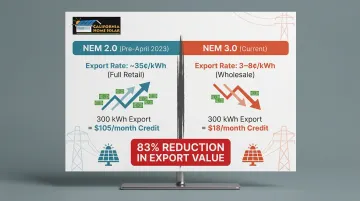
Under NEM 2.0, every kilowatt-hour exported to the SCE grid was credited at the full retail rate—approximately 35 cents/kWh. Under NEM 3.0, those same exports earn the wholesale avoided cost rate of 3-8 cents/kWh.
Side-by-side comparison: A homeowner exporting 300 kWh per month would earn:
- NEM 2.0: 300 kWh × $0.35 = $105 monthly credit
- NEM 3.0: 300 kWh × $0.06 (average) = $18 monthly credit
This represents an 83% reduction in export value, reshaping solar economics.
NEM 2.0 Grandfathering
Customers who interconnected before April 14, 2023 remain on NEM 2.0 for 20 years from their original interconnection date. A customer who interconnected in 2022 will stay on NEM 2.0 until 2042. After that 20-year period, they'll transition to whatever net metering structure exists at that time, most likely on terms similar to or less favorable than today's NEM 3.0.
If you're an existing NEM 2.0 customer nearing the end of your grandfathering window, review your system's performance now and consider adding battery storage before you transition — it's the most effective way to protect the value of your solar investment.
How Optimal System Design Changed
NEM 2.0 strategy: Oversizing solar systems to maximize exports was financially rewarding, since every exported kWh earned full retail credit.
NEM 3.0 strategy: Size systems to cover on-site consumption as closely as possible. Pair with battery storage to reduce grid exports during low-value daytime hours and shift usage to higher-value evening periods when you'd otherwise import at 35 cents/kWh.
Impact on Payback Period
NEM 3.0 has extended typical solar payback timelines in SCE territory:
- NEM 2.0 solar-only: 5-6 years
- NEM 3.0 solar-only: 9-12 years
- NEM 3.0 solar + battery: 7-9 years
SCE's retail rates remain among the highest in California, so direct solar consumption still delivers real savings — but the math only works in your favor with proper system sizing. For most NEM 3.0 homeowners, pairing solar with a battery cuts that payback window by 2-3 years and makes the economics genuinely competitive.
SCE Solar Incentives, Rebates, and Battery Programs
SGIP Battery Storage Rebate
The Self-Generation Incentive Program (SGIP), administered through SCE, provides upfront rebates to offset battery storage costs:
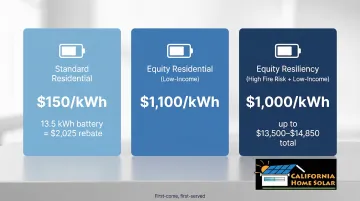
- Small Residential Storage: $150/kWh (standard customers)
- Residential Storage Equity: $1,100/kWh (low-income customers)
- Equity Resiliency: $1,000/kWh (low-income customers in high fire-risk areas)
SGIP funding operates on a first-come, first-served basis with decreasing incentive levels as more homeowners enroll. As of early 2026, standard residential incentives are in Step 7 ($0.15/Wh), while equity budgets remain at higher levels.
Under NEM 3.0, export credits are worth far less during peak solar generation hours (midday). A battery lets you store that energy and use it in the evening instead of drawing from the grid at full retail rates. For a typical 13.5 kWh battery, the standard SGIP rebate works out to $2,025. Equity customers can receive $13,500–$14,850, which covers most or all of the battery cost outright.
California Property Tax Exclusion
The Active Solar Energy System Exclusion prevents solar panels from increasing your home's assessed property tax value. This exclusion is currently set to expire January 1, 2027. Systems completed after this date may trigger a property tax reassessment, increasing the ongoing cost of ownership.
As of early 2026, no legislation has extended this exclusion beyond the January 1, 2027 deadline. Homeowners considering solar should complete installation before this date to preserve this benefit.
DAC-SASH for Qualifying SCE Customers
The Disadvantaged Communities – Single-family Affordable Solar Housing (DAC-SASH) program offers $3 per watt for solar systems between 1 and 5 kW to income-qualified SCE customers living in top 25% disadvantaged communities as identified by CalEnviroScreen 4.0.
Eligibility requirements:
- Homeowner (not renter) in a top 25% DAC per CalEnviroScreen 4.0
- Qualify for CARE/FERA programs or reside in California Indian Country
- System size between 1-5 kW
For a 5 kW system, this equals $15,000 in upfront incentives. Check your address eligibility using the CalEnviroScreen 4.0 map and contact GRID Alternatives to apply.
PACE / HERO Financing
Property Assessed Clean Energy (PACE) financing lets SCE homeowners install solar with no money upfront. California Home Solar is a HERO Registered Contractor, so this option is available to qualified Southern California homeowners directly through us.
Key features of HERO financing include:
- Payments added to your property tax bill — no separate loan payment
- Loan transfers with the home if you sell
- Approval based on home equity and payment history, not credit score
- Flexible terms from 5–25 years with zero application fees
- Does not affect eligibility for utility, city, county, or federal rebates
The Federal Solar Tax Credit: What SCE Homeowners Need to Know Now
The federal Residential Clean Energy Credit (Section 25D) offers a 30% tax credit on the total installed cost of a solar system — including battery storage added at the same time. Under the Inflation Reduction Act, this credit runs at 30% through 2032, then steps down to 26% in 2033 and 22% in 2034 before expiring. For a typical $20,000 SCE-area installation, that's a $6,000 direct reduction in your federal tax bill.
The credit applies to the year your system is placed in service — not when you sign the contract. That timing matters if your installation spans a calendar year.
What this means for SCE homeowners:
- Projects placed in service through 2032 qualify for the full 30% credit — claim it in the tax year your system goes live
- The credit covers equipment and installation labor, so your full contracted cost counts toward the calculation
- State-level incentives (SGIP, DAC-SASH) and the property tax exclusion become even more critical for financial viability
- High SCE retail rates (35.3 cents/kWh) still make solar one of the smartest investments SCE customers can make
Stacking the federal credit with California's SGIP battery incentive and the property tax exclusion can dramatically shorten your payback period — often to under 7 years in SCE territory.
Is Solar Still Worth It for SCE Customers Under NEM 3?
Yes—despite NEM 3.0's reduced export credits and the expiration of the federal tax credit, solar remains financially worthwhile for most SCE customers due to high local electricity rates.
The math is straightforward: Every kilowatt-hour generated and consumed on-site saves 35.3 cents. For a typical Los Angeles County household using 700 kWh monthly, a properly sized 7 kW solar system generating 900 kWh monthly and consuming 600 kWh on-site delivers:
- On-site consumption savings: 600 kWh × $0.353 = $212 monthly
- Export credits (with adder): 300 kWh × $0.06 = $18 monthly
- Total monthly benefit: $230
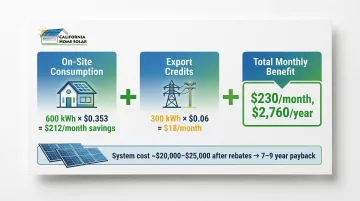
Over a year, this equals $2,760 in savings. With average system costs around $20,000-$25,000 after SGIP battery rebates, payback periods of 7-9 years remain attractive compared to the 25+ year lifespan of equipment.
How to get the most out of NEM 3.0:
- Size solar to cover daytime loads without significant oversizing
- Pair with battery storage to capture excess daytime generation
- Discharge battery during evening peak hours (4-9 PM) when retail rates are highest
- Shift discretionary loads (EV charging, laundry, dishwasher) to midday solar hours
- Align with SCE's time-of-use rates to minimize grid imports during expensive periods
Together, these steps significantly reduce grid dependency even with lower export credits. The critical variable is system sizing — too large and you're exporting cheaply, too small and you're still buying peak-rate power. California Home Solar has been installing systems in Southern California for 36 years and holds a Top 500 Solar Contractor designation, bringing direct familiarity with SCE's billing structure and local rate schedules to every project.
Frequently Asked Questions
Does SCE pay you for solar energy?
Yes, SCE compensates solar customers for excess energy exported to the grid through the Solar Billing Plan (NEM 3.0). However, credits are based on wholesale avoided cost rates (3-8 cents/kWh) rather than full retail rates, and are applied monthly with any surplus settled at the annual true-up date at approximately 2-3 cents/kWh.
How much is NEM 3.0 per kWh?
NEM 3.0 export credits under SCE vary by time of day, day of week, and month using the CPUC's Avoided Cost Calculator. Credits average approximately 3-8 cents/kWh depending on timing, compared to the ~35.3 cents/kWh retail rate SCE customers pay for imported electricity.
What is the difference between SCE NEM 2 and NEM 3?
NEM 2.0 credited exports at the full retail electricity rate (~35 cents/kWh), while NEM 3.0 credits exports at the lower wholesale avoided cost rate (3-8 cents/kWh)—roughly 75-85% less. This makes on-site consumption and battery storage much more important under NEM 3.0 than under the previous program.
Is solar worth it under NEM 3?
Solar remains financially worthwhile for SCE customers given high local electricity rates (35.3 cents/kWh), particularly when systems are sized for on-site consumption and paired with battery storage. Payback periods of 7-9 years for solar-plus-storage are attractive against 25+ year equipment lifespans.
What is the 30% solar credit in California?
The 30% credit is a federal (not California state) tax incentive under Section 25D of the Internal Revenue Code, extended through 2032 under the Inflation Reduction Act. Homeowners who own their system and have sufficient tax liability can claim it in the year their system is placed in service.
Why is my electric bill so high if I have solar panels?
Several factors can keep your bill high even with solar:
- System is undersized for your actual usage
- Evening grid imports are billed at full retail rates (35 cents/kWh) under NEM 3.0, while excess exports earn only 3-8 cents/kWh
- Fixed utility charges cannot be offset by solar credits
- Usage has grown since the system was designed (new EV, appliances, or occupants)