Introduction
California homeowners who went solar after April 2023 are operating under fundamentally different rules — ones that significantly reduce how much credit they earn for excess solar power sent to the grid. The shift to NEM 3.0 (officially called the Net Billing Tariff) replaced the previous net metering system and cut export credit rates by roughly 75%, leaving many homeowners wondering whether solar still makes financial sense.
Under the old system, homeowners earned retail-rate credits for every kilowatt-hour they exported. Now, those same exports earn just a fraction of that value. For Southern California homeowners served by SCE, the math has changed — but solar savings haven't disappeared. This guide breaks down what NEM 3.0 actually means, how it compares to the old rules, and what steps help you get the most out of your system under the new tariff.
TLDR
- NEM 3.0 replaced NEM 2.0 on April 15, 2023 for all new solar interconnection applications in California
- Export credits dropped roughly 75%, from retail rates to avoided-cost rates averaging around $0.08/kWh
- Homeowners with Permission to Operate before April 2023 remain on NEM 2.0 for 20 years
- Battery storage is now essential — pairing it with solar is the primary way to maximize savings under NEM 3.0
- Solar in Southern California can still deliver strong returns, especially with rising SCE rates
What Is NEM 3.0 and Why Did California Change Its Net Metering Rules?
NEM 3.0 is California's third iteration of its net energy metering policy, officially approved by the California Public Utilities Commission (CPUC) in December 2022 and implemented April 15, 2023. It governs how solar customers are compensated for electricity they export to the grid. For homeowners who went solar under earlier rules, it marks a significant change in how exports are valued.
The CPUC's Rationale: The Cost-Shift Argument
The CPUC argued that previous NEM programs (NEM 1.0 and NEM 2.0) created a cost-shifting problem. Because solar customers paid less in volumetric utility charges, they contributed less toward grid maintenance and infrastructure costs. Regulators claimed utilities shifted those costs to non-solar customers — an inequity the commission said needed correction.
The new tariff was designed to align compensation with the "value of solar to the grid" rather than retail electricity rates. That means the one-to-one credit model that made solar financially attractive for decades no longer applies under NEM 3.0.
How We Got Here
NEM 1.0 to 2.0:
- NEM 1.0 offered full retail credit for exports
- Between 2016-2017, utilities hit their program caps (PG&E reached its cap in December 2016)
- NEM 2.0 introduced minor reductions but maintained retail-rate credits
- NEM 3.0 represents a far more dramatic restructuring
Current Legal Status
NEM 3.0 is also facing active legal scrutiny. In August 2025, the California Supreme Court unanimously sent the CPUC's decision back to a lower court for further review, siding with environmental groups who argued the commission failed to adequately consider benefits to customers and disadvantaged communities. The policy remains in effect while this review proceeds, but homeowners should track updates as the review unfolds.
Which Utilities Does NEM 3.0 Apply To?
NEM 3.0 applies exclusively to California's three investor-owned utilities:
- PG&E (Pacific Gas & Electric)
- SCE (Southern California Edison — serving most California Home Solar customers)
- SDG&E (San Diego Gas & Electric)
Publicly-owned utilities like LADWP operate under their own separate net metering policies and have not adopted NEM 3.0.
NEM 3.0 vs. NEM 2.0: What Changed for Solar Savings
NEM 3.0 changed how much money California homeowners can earn from solar exports — and the difference is substantial.
The Core Structural Difference
Under NEM 2.0, solar exports were credited at the retail electricity rate — the same rate you pay per kWh. Every kWh sent to the grid offset one kWh of future consumption at full retail value, a straightforward one-to-one exchange.
NEM 3.0 replaced that with an "avoided cost" model. Credits now reflect what the utility saves by not buying that electricity on the wholesale market, which is far lower than retail and tied to grid economics rather than your bill.
Quantifying the Change
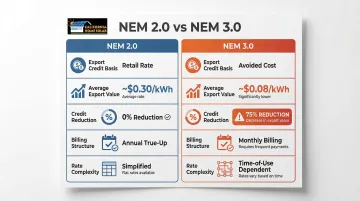
| Feature | NEM 2.0 | NEM 3.0 |
|---|---|---|
| Export Credit Basis | Retail Rate | Avoided Cost Calculator |
| Average Export Value | ~$0.30/kWh | ~$0.08/kWh |
| Credit Reduction | Baseline | ~75% lower |
| Billing Structure | Annual True-Up | Monthly Billing |
| Rate Complexity | Simple TOU periods | 576 rate combinations |
Research shows that average export credits dropped from approximately 30 cents per kWh under NEM 2.0 to around 8 cents per kWh under NEM 3.0 — a roughly 75% reduction in value.
The Complexity of NEM 3.0 Export Rates
Unlike NEM 2.0's relatively straightforward Time-of-Use periods, NEM 3.0 rates are highly dynamic. Export credits vary by:
- Hour of day (24 distinct hourly rates)
- Day type (weekday vs. weekend)
- Month, with 12 seasonal rate variations
That adds up to 576 possible export rate combinations. Tracking these manually isn't realistic — battery storage or an energy management system is effectively required to get the most from your system.
The Grandfather Clause
Existing NEM 2.0 customers who received Permission to Operate (PTO) before April 15, 2023 remain on NEM 2.0 terms for 20 years from their PTO date.
Transition window: Applicants who submitted complete interconnection applications before April 14, 2023 have until April 14, 2026 to complete their installations and still qualify for NEM 2.0 terms. Be aware that major system upsizing after that deadline can void grandfather status.
Solar Payback Period Impact
Under NEM 2.0, typical payback periods ran 5-7 years for solar-only systems. With export credits cut by roughly 75%, NEM 3.0 pushes those timelines further out for homeowners who install panels alone.
However, according to CPUC estimates, solar-plus-storage systems can achieve approximately a 9-year payback period under NEM 3.0 — making battery storage the key to maintaining competitive returns.
How NEM 3.0 Bill Credits Are Calculated in Practice
The Avoided Cost Calculator (ACC)
The CPUC developed the Avoided Cost Calculator to determine how much utilities save by accepting solar energy from customers instead of buying it on the open market. This calculated wholesale value — not the retail rate you pay for electricity — becomes the basis for all NEM 3.0 export credits.
The ACC estimates the marginal cost a utility avoids by purchasing energy from a solar customer rather than generating it elsewhere. These values are averaged over climate zones for each utility and updated annually.
How Time-of-Use Rates Interact with NEM 3.0
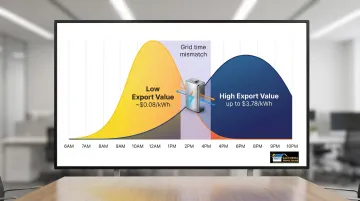
Export credits are highest during peak demand windows , typically late afternoon and early evening, when grid demand is highest. They're lowest during midday when solar production naturally peaks and grid supply is abundant.
For SCE customers, this creates a significant timing mismatch:
- Lowest export value: 10 AM - 2 PM (when your panels produce the most)
- Highest export value: 4 PM - 9 PM (when your panels produce less)
In September 2024, SCE export rates between 6 PM and 8 PM on weekdays ranged from $3.36/kWh to $3.78/kWh — far above midday rates. This pricing structure incentivizes storing midday solar energy and using it at home or exporting it during evening peak hours.
Monthly Billing Cycle
NEM 3.0 uses a monthly billing structure rather than NEM 2.0's annual true-up. Customers receive monthly credits for exported energy applied directly against their utility bill.
Key billing details to know:
- Unused credits roll over each month
- Non-energy charges are due monthly
- Monthly billing prevents the large unexpected year-end bills common under NEM 2.0
Common Misconceptions About NEM 3.0
Misconception #1: NEM 3.0 eliminates net metering entirely
Solar customers still receive compensation for exports, but at avoided-cost rates rather than retail rates. The program restructured how credits are calculated, not whether they exist.
Misconception #2: Solar is no longer worth it in California
Rising retail electricity rates from SCE and other utilities directly improve the value of solar self-consumption. CalMatters reports that while export values dropped, falling solar system prices have partially offset the lower export credits, and solar-plus-storage systems can still deliver strong returns.
Which California Solar Customers Are Affected by NEM 3.0
NEM 3.0 applies to any residential or commercial customer of PG&E, SCE, or SDG&E who submitted a new interconnection application on or after April 15, 2023. Customers under NEM 1.0 or NEM 2.0 with existing PTO dates remain grandfathered for 20 years.
Impact on the California Solar Industry
The policy shift had immediate and severe consequences for California's solar industry. Following the April 2023 deadline, residential interconnection requests dropped by approximately 82% compared to the prior year. Industry estimates indicate that roughly 17,000 solar and storage jobs were lost or planned to be cut by the end of 2023 due to the policy change.
Special Provisions for Low-Income Customers
NEM 3.0 includes equity provisions for disadvantaged communities. Low-income customers enrolled in CARE or FERA programs receive higher export rate adders than standard customers:
- SCE CARE customers: $0.093/kWh export rate adder
- SCE non-CARE customers: $0.040/kWh export rate adder
- Target payback period: ~9 years for qualifying low-income households
These adders help offset the lower base export rates under NEM 3.0, making solar more viable for customers who need savings the most.
How to Maximize Solar Savings Under NEM 3.0
Prioritize Battery Storage
Since NEM 3.0 credits vary dramatically by time of day, the most effective strategy is pairing solar with a home battery system. Store excess solar energy during low-export-value midday hours, then either self-consume that stored energy in the evening or export it during peak TOU windows when export credits can exceed $3.00/kWh.
Battery storage lets you capture energy when it's abundant and use it when it's most valuable, turning NEM 3.0's timing mismatch into a financial advantage.
Optimize Self-Consumption
Under NEM 3.0, every kWh used directly from your solar panels is worth more than a kWh exported and credited back. Shift high-consumption activities to daytime solar hours:
- Schedule EV charging for midday when solar production peaks
- Run dishwashers, washing machines, and dryers during solar hours
- Program pool pumps and HVAC to operate while solar is producing
The value gap is substantial — avoiding a $0.30-$0.60/kWh grid purchase is far more valuable than earning a ~$0.08/kWh export credit.
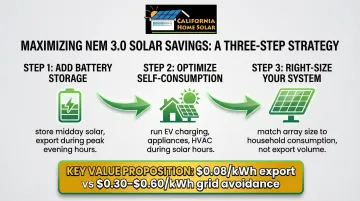
Right-Size Your System
Under NEM 3.0, oversizing a solar array to export large volumes at low avoided-cost rates isn't optimal. A well-sized system matched to household consumption — ideally paired with battery storage — delivers better financial returns.
Southern California homeowners working with experienced installers like California Home Solar can receive customized system designs that account for NEM 3.0 dynamics, local SCE TOU rate structures, and household-specific energy profiles. With 36 years serving the Los Angeles area, the company designs systems sized for how you actually use energy — not how the grid used to reward exports.
Frequently Asked Questions
What is NEM 3.0 in California and how will it affect solar owners?
NEM 3.0 is California's current net metering policy that took effect April 15, 2023, reducing export credits from retail rates to lower "avoided cost" rates. New solar customers earn roughly 75% less for exported energy, so battery storage and daytime self-consumption become the primary tools for protecting your bill savings.
What is the difference between NEM 2.0 and NEM 3.0 in California?
NEM 2.0 credited solar exports at the full retail electricity rate in a one-to-one exchange. NEM 3.0 uses avoided cost rates based on wholesale market values — resulting in roughly a 75% reduction in export credit value, plus dynamic TOU-based pricing that varies by hour, day, and season.
How is net billing calculated under NEM 3.0 in California?
Export credits are calculated using the CPUC's Avoided Cost Calculator, with rates that vary by hour of day, day of week, and season. These rates reflect what the utility saves by not purchasing power on the wholesale market rather than the retail rate customers pay.
How much does NEM 3.0 pay out to solar customers in California?
NEM 3.0 export rates average around $0.08/kWh — significantly lower than the ~$0.30/kWh retail rates under NEM 2.0. However, peak-hour exports during summer evenings can earn credits exceeding $3.00/kWh, so timing battery discharge to those peak hours pays off.
How much can solar save on an electric bill in California?
Most Southern California homeowners under NEM 3.0 see annual bill reductions of $800–$1,500 for a standard residential system, with battery storage pushing savings higher. The exact amount depends on system size, your utility (SCE, LADWP, SDG&E), and how much of your solar production you use directly rather than export.
What does a net tariff mean for California solar customers?
"Net billing tariff" (the official CPUC term for NEM 3.0) means customers are billed for the net difference between electricity consumed from the grid and credits earned for exports. Unlike classic net metering, the export credit rate is now decoupled from the retail rate customers pay for grid electricity.