Introduction
You've made the decision to go solar—or you're seriously considering it. Either way, one question keeps coming up: will these panels still be cranking out electricity in 10, 20, or even 30 years?
For Southern California homeowners, the real question is whether your investment holds up under intense UV exposure, coastal salt air, and the dust kicked up by Santa Ana winds. California's climate is mostly favorable for solar longevity — but Los Angeles-area conditions create specific challenges that affect how long your system lasts.
This article covers the expected lifespan of panels in California, how local climate micro-zones affect degradation, what factors you control as a homeowner, and how to protect your investment for decades to come.
TLDR: Key Takeaways
- Quality solar panels last 25–30 years in California, retaining roughly 80% of original output by year 25
- California's climate extends system life overall, though coastal humidity, inland heat, and wildfire ash each demand specific attention
- Panels degrade gradually at around 0.5% per year—your system generates meaningful power well past its warranty period
- Choose quality panels, hire a professional installer, and keep up with basic maintenance—those three factors determine most of your system's longevity
How Long Do Solar Panels Actually Last in California?
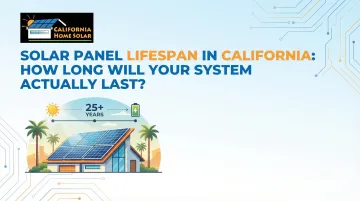
Modern residential solar panels are built to operate for 25–30 years at or near peak performance. After that, they continue generating power at reduced output levels rather than stopping abruptly.
The 80% Benchmark
Most manufacturers design and warranty their panels to retain at least 80% of their original power output after 25 years. According to NREL research, the median degradation rate is just 0.5% per year, meaning panels typically retain over 80% of their power output at the 25-year mark.
Some premium manufacturers exceed this standard. For example, REC guarantees 92% power output in year 25 for its Alpha Pure 2 series.
Beyond the Warranty Period
Reaching the end of a warranty period doesn't mean a panel stops working — most continue generating electricity for 30–40 years at gradually reduced efficiency. A study of 30-year-old PV modules in Northern California found they were still operational, producing 28.4 W compared to their original 41.0 W nameplate rating—about 69% of original capacity.
Panel Technology and Longevity
Not all panels age the same way:
- Monocrystalline: Highest efficiency and longest-lasting, with degradation rates in the 0.5–0.6% per year range
- Polycrystalline: Slightly shorter lifespan and lower efficiency than monocrystalline
- Thin-film: Shortest lifespan and less common in residential California installs
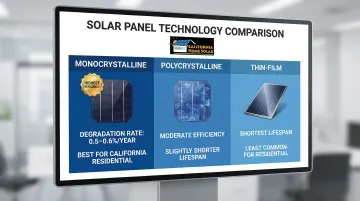
The panel type you choose affects both how quickly your system pays off and how much it produces in year 20 versus year 10—which brings the financial picture into focus.
Financial Logic of Long-Term Ownership
California's abundant sunshine accelerates payback periods. Your system typically pays for itself well before it shows meaningful degradation—often within 6–10 years. That leaves 15–20 years of uninterrupted generation at modest cost, even accounting for gradual efficiency loss.
How California's Climate Affects Your Solar Panels
California is not one climate. For LA-area homeowners, your local micro-zone directly affects how long your panels last.
Coastal Communities (Malibu, Manhattan Beach, Redondo Beach, Long Beach)
Salt-laden ocean air is one of the more aggressive environmental stressors for solar panels. It can cause corrosion on metal frames, junction boxes, and mounting hardware over time.
What to look for:
- Panels with IEC 61701 salt mist certification—this standard tests modules in a salt spray chamber to simulate coastal conditions
- Severity Level 6 is the highest certification, verifying resistance under rigorous conditions
- Corrosion-resistant mounting hardware and junction boxes
Without proper coastal-rated equipment, salt mist can degrade electrical connections and shorten system life.
Inland and Valley Areas (San Fernando Valley, San Gabriel Valley, Antelope Valley, Palmdale)
Extreme summer heat—routinely exceeding 100°F—causes thermal stress on panels.
Temperature coefficient matters:
- This metric indicates how much power a panel loses for every degree Celsius above 25°C
- REC Alpha Pure 2: -0.24% per °C (excellent for hot climates)
- REC TwinPeak 5: -0.34% per °C (standard performance)
While high heat reduces real-time output slightly, quality panels are engineered to handle this. The greater concern is repeated thermal cycling—expansion and contraction over decades that can stress wiring and seals.
Desert-Adjacent and High-Wind Areas (Antelope Valley, Lancaster, Palmdale)
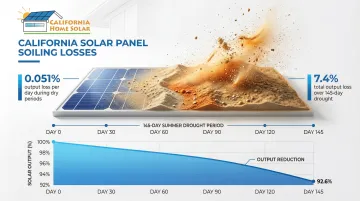
Dust, sand, and wildfire ash common to these areas accumulate on panel surfaces, reducing output.
Soiling losses in California:
- A study of 186 California PV sites found soiling losses averaged 0.051% per day during dry periods
- Over a typical 145-day summer drought, accumulated soiling can result in a 7.4% output loss—enough to meaningfully shorten your system's effective production life if panels aren't cleaned regularly