For California homeowners, protecting a home from harsh weather is a practical necessity. From strong winds to constant sun exposure, your roof plays a critical role in safeguarding your property.
Large U.S. infrastructure projects often provide useful insights, and the Tropicana Field roof panel installation is a clear example of how thoughtful material selection and structural design can handle extreme conditions.
The approach used in this project explains why materials like PTFE-coated fiberglass are chosen for high-wind environments. These same considerations apply to Southern California homes, especially when securing rooftop solar systems in areas exposed to wind and heat.
Key Takeaways
The new roof uses a thicker, more durable Teflon-coated fiberglass (PTFE) designed to withstand winds up to 165 mph, a 43% increase in strength over the original 115 mph design.
The installation involved 24 massive panels, each weighing approximately 5,000 pounds, requiring a complex network of 180 miles of tensioned cables for structural support.
Despite a 56-day delay due to volcanic activity in Russia disrupting air freight, the roof reached a water-tight state ahead of schedule in late 2025.
The city of St. Petersburg invested nearly $60 million in total stadium remediation, highlighting the value of maintaining existing infrastructure even with a new stadium planned for 2028.
What is the Tropicana Field Roof Panel Installation?
The Tropicana field roof panel installation is a large-scale structural restoration project necessitated by the catastrophic damage caused by Hurricane Milton in October 2024. The original dome, which had stood since 1990, was damaged by 110-mph winds, leaving the interior exposed to the elements for over a year.
Unlike standard commercial roofing, the Tropicana Field dome is the world’s second-largest cable-supported domed roof. The installation process is not about laying shingles; it is about stretching a high-tech fabric membrane over a skeleton of steel cables.
For California residents familiar with strong seasonal wind events, the engineering logic used here, prioritizing tension and flexibility over rigid weight, is a familiar strategy for surviving high-energy weather events.
Understanding the magnitude of this project requires a look at the specific steps taken to ensure the new structure exceeds the performance of the original.
The Technical Process of Installing Stadium Roof Panels
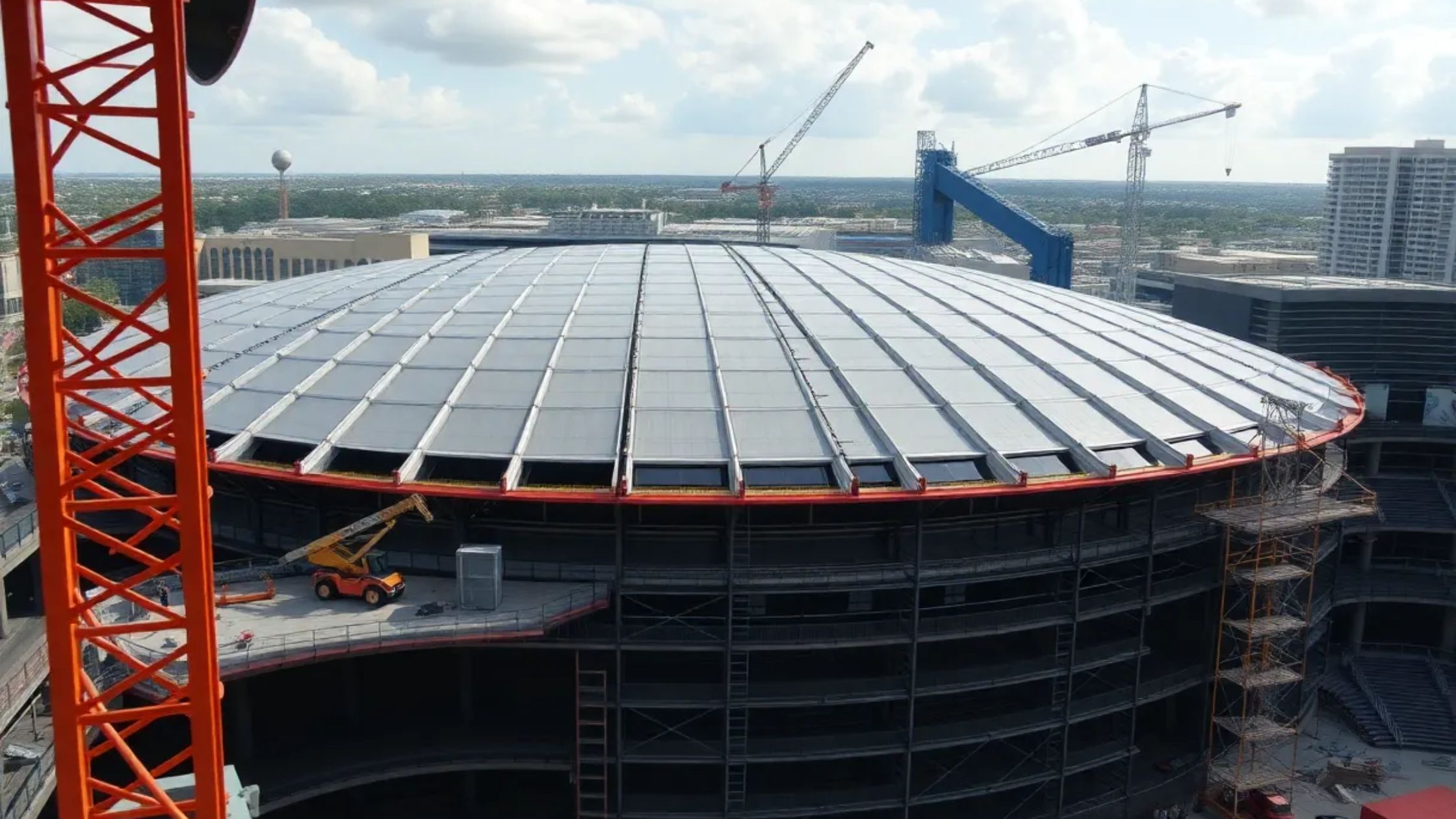
The Tropicana field roof panel installation required a specialized global supply chain and a team of international engineers. The process can be broken down into distinct phases that ensure the structural integrity of the 370,000-square-foot canopy.
1. Structural Assessment and Remediation
Before a single panel could be hoisted, engineers conducted a 412-page facility damage assessment. They confirmed that while the fabric was gone, the primary cable-supported structure remained in good condition.
This is a critical lesson for any property owner: the underlying structure must be verified as sound before applying expensive new surface materials.
2. Material Fabrication and Global Logistics
The 24 panels were manufactured by the Serge Ferrari Group in Germany, using high-performance fiberglass yarns coated with Polytetrafluoroethylene (PTFE). After being fabricated in Europe, the panels were sent to China for final assembly by Enclos Tensile Structures.
The logistics were so complex that a volcanic eruption in eastern Russia actually grounded the air freight flights, highlighting how global supply chains can impact local construction timelines.
3. Netting and Work Platform Integration
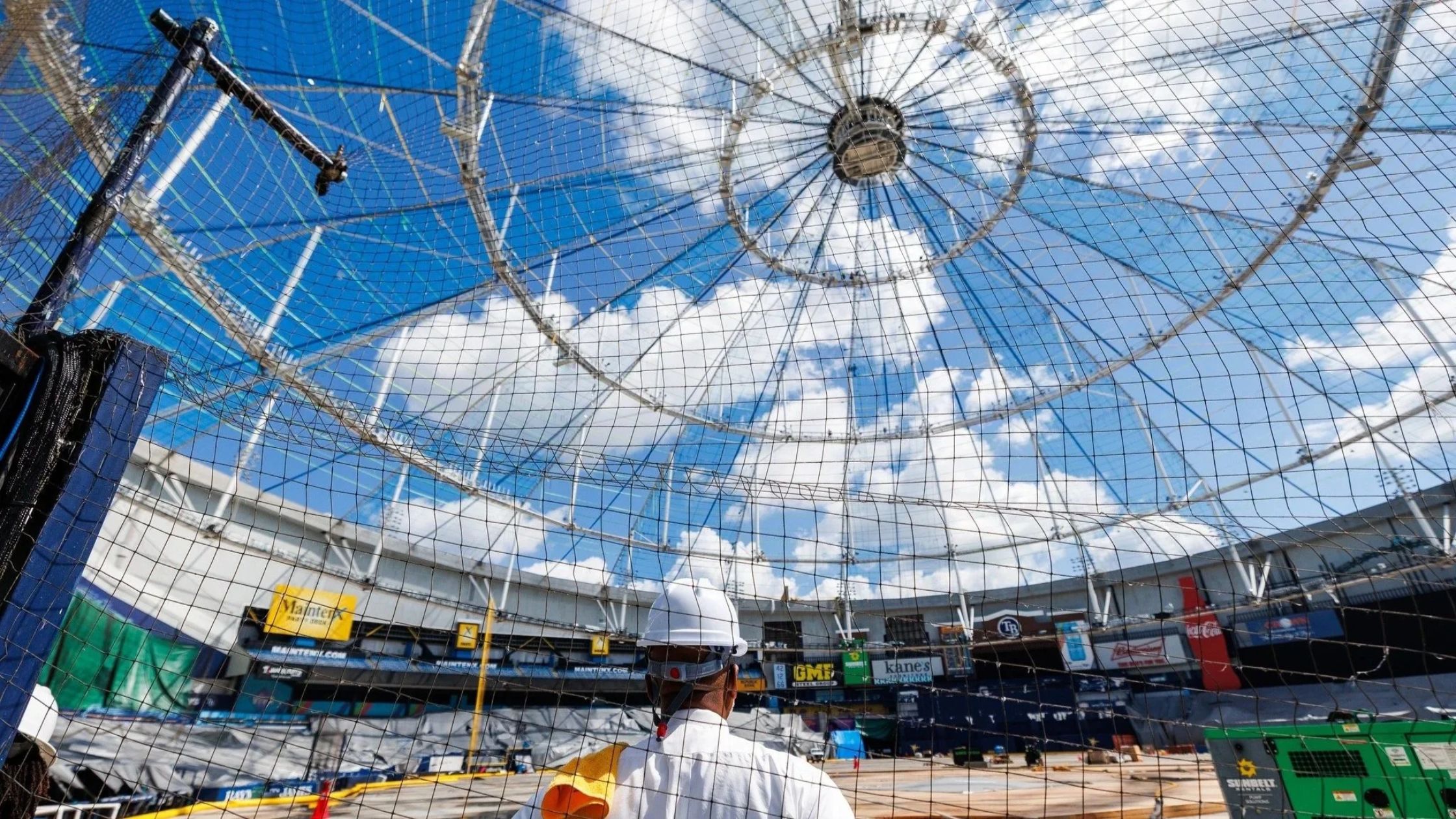
One of the most unique aspects of the Tropicana field roof panel installation was the use of a massive netting system. Crews placed heavy-duty netting across the interior of the stadium to act as a horizontal work platform.
This allowed technicians to move hundreds of feet above the stadium floor safely while securing the 5,000-pound panels to the cable struts.
4. Tensioning and Edge Sealing
Once the panels were in place, they were not simply bolted down. The Tropicana field roof panel installation relies on tensioning, where the fabric is pulled tight using the stadium cables.
This tension creates the strength needed to resist hurricane-force winds. After the panels are positioned, workers perform edge sealing, a process of welding the fabric edges together to create a single, waterproof environment.
5. Natural Color Transformation and Finishing
When first installed, the PTFE panels often have an orange-tan tint. A fascinating part of the Tropicana field roof panel installation is the color change phase. Over approximately three months, exposure to the Florida sun naturally lightens the fabric to a brilliant, reflective white.
This white color is functional; it reflects solar heat, significantly reducing the energy required to cool the interior of the dome.
While the physical installation is impressive, the materials chosen for this project represent the pinnacle of modern architectural fabric technology.
Also Read: The Advantage of USA Made Solarworld Panels For Your Home or Business
Materials Matter: Why PTFE-Coated Fiberglass was Selected
A core component of the Tropicana field roof panel installation is the choice of Polytetrafluoroethylene (PTFE) coated fiberglass. When the original roof was built in 1990, this was the industry standard for durability.
However, the 2025 version features significant upgrades in chemical composition and weave density.
Enhanced Wind Resistance
The most significant upgrade in the new installation is the wind rating. The original roof was rated for 115 mph. Given the increasing frequency of severe weather, the new panels were engineered to withstand 165 mph.
This was achieved by increasing the thickness of the fiberglass core and improving the bond between the glass fibers and the Teflon coating.
Self-Cleaning Properties
PTFE is essentially a non-stick surface. In a coastal environment where salt spray and industrial pollutants are common, the Tropicana field roof panel installation provides a low-maintenance solution.
Rainwater effectively washes away dirt, ensuring the roof remains reflective and efficient over its 20-year service life.
Light Transmissivity
For professional baseball, lighting is everything. The fiberglass panels are translucent, allowing approximately 7% to 15% of natural sunlight to pass through. This creates a diffused, shadow-free environment that is ideal for high-speed sports while still blocking 100% of harmful UV rays.
With the material science secured, the city turned its attention to the massive financial and logistical undertaking of the rebuild.
Comparing the New Roof to the Original 1990 Design
The 2025-2026 restoration was not a simple replacement. Engineers utilized the opportunity to upgrade the stadium defenses. For California homeowners considering a roof upgrade before solar, this philosophy is the most cost-effective way to future-proof a property.
Feature | Original 1990 Roof | 2026 Replacement Roof |
Material | Teflon-coated fiberglass | Enhanced, thicker PTFE composite |
Wind Resistance | 115 MPH | 165 MPH |
Panel Count | 24 | 24 |
Total Cost | Part of original $138M build | $22.5M (Roof only) |
Service Life | ~30 years | 20+ years (Projected) |
The decision to invest in a 165-mph wind rating reflects a growing trend in coastal construction: building for extreme scenarios rather than average weather.
As the exterior reached completion, the focus shifted to the massive internal remediation required after months of exposure to the elements.
Also Read: Buy or Lease Your Solar Panels? You need to know this.
Beyond the Panels: The Interior Remediation Process
The Tropicana field roof panel installation was only the first step in a broader $60 million project. Because the stadium was without a roof for nearly a year, the interior sustained significant damage that required a complete overhaul of the facility's core systems.
Drainage and Waterproofing
Tropicana Field was designed as an indoor-only facility, meaning it lacked a standard drainage system for the playing field. During the months it sat exposed, crews had to install temporary pumps and waterproofing to prevent the structure from rotting from the inside out.
Once the roof was sealed in late 2025, a massive dehumidification process began to prepare the space for new finishes.
Turf and Lighting Upgrades
With the new roof in place, the stadium is receiving a state-of-the-art artificial turf system. Additionally, the sports lighting and audio-visual systems, which were essentially ruined by rainwater, are being replaced with 2026-standard LED technology.
This ensures that when the Rays return, the fan experience is actually improved compared to the pre-hurricane era.
The transition from a stadium rebuild to a residential solar project may seem large, but the fundamental engineering principles remain identical.
Why Stadium Engineering Matters to Solar Homeowners
You might wonder why a solar company is discussing a stadium roof in Florida. The answer lies in structural engineering logic. When CA Home Solar designs a system for a home in the Inland Empire or Riverside, we face similar challenges to those found in the Tropicana field roof panel installation.
Wind Load and Uplift
Just as the Tropicana Field roof must resist uplift (the wind trying to peel the roof off), a solar array must be engineered to stay attached during high-wind events.
We use specific mounting hardware and stand-offs that distribute the load across the rafters, mirroring the tensioning logic used in stadium domes.
Thermal Reflection and Energy Efficiency
The white PTFE membrane of the Trop is designed to reflect solar energy. Similarly, we often recommend that California homeowners evaluate their roof color and material before installing solar.
A cool roof combined with solar panels creates a dual-layer of heat protection, significantly lowering your AC demand during our 100°F+ summer days.
Longevity and Maintenance
The city of St. Petersburg chose a material with a 20-year lifespan. At CA Home Solar, we match your solar system to the life of your roof. If your roof has less than 10 years of life left, we recommend a roofing remodel first.
It is far more expensive to remove and reinstall solar panels later than it is to start with a fresh, resilient foundation.
Why Choose CA Home Solar for Your Energy Needs?
For California homeowners, local experience and consistent project handling make a noticeable difference from start to finish. Based on our service approach and regional knowledge, CA Home Solar has become a reliable choice for residential solar projects.
Here are the key reasons homeowners work with CA Home Solar:
Decades of Experience: We understand California’s complex utility landscape and high-wind zone requirements.
Full Project Responsibility: Our team manages evaluation, design, permits, installation, and utility interconnection.
Resilience-Focused Design: We ensure your roof and solar system are engineered to handle local weather patterns.
Long-Term Cost Predictability: We help you convert volatile utility bills into predictable payments.
If you want to see how these systems come together on real properties, explore our recent work to view completed projects and installation examples across Southern California.
Wrapping Up
The Tropicana field roof panel installation is a testament to what is possible when modern engineering meets specialized material science. By upgrading to a 165-mph wind rating and utilizing high-performance PTFE composites, the city has ensured that the stadium can serve as a safe, functional asset for the community.
For our customers at CA Home Solar, the lesson is clear: resilience is not an accident. It is the result of careful material selection and a commitment to structural integrity.
Whether you are protecting a Major League ballpark or your family home in Southern California, the foundation of energy independence is a roof that can stand up to the elements.
Contact CA Home Solar today to schedule a consultation and find out how a professionally installed solar system could work for your home.
Frequently Asked Questions (FAQs)
1. Why did the Tropicana Field roof installation take over a year to complete?
The damage occurred in October 2024. The delay was caused by the need for a 412-page structural audit, the global manufacturing of custom composite panels in Germany, and a 56-day logistics delay caused by volcanic activity in Russia. The actual panel installation began in August 2025 and finished in November 2025.
2. Is the new roof on Tropicana Field permanent?
Yes, it is a permanent replacement designed to last 20+ years. Even though a new stadium is planned for 2028, the city is contractually obligated to provide a suitable playing environment for the Rays through the end of their lease.
3. What is the material used in the Tropicana field roof panel installation?
The roof is made of a PTFE (polytetrafluoroethylene) coated fiberglass membrane. This composite material is translucent, allowing light in while reflecting heat, and is engineered to be flexible enough to handle high wind pressures without tearing.
4. How much did the roof repair cost?
The roof installation itself cost approximately $22.5 million. The total stadium remediation, which includes turf replacement, electronics, and interior repairs, is estimated at $59.7 million. Much of this is expected to be covered by insurance and FEMA reimbursements.
5. Why do the new roof panels look different during the process?
When first installed, the panels have a tan or orange tint due to the manufacturing process. Over a period of roughly three months, the UV rays from the sun naturally lighten the fabric until the entire dome appears uniform and white.