
Introduction
If you're a Los Angeles homeowner researching solar, you've likely seen alarming headlines about California's NEM 3.0 policy slashing solar savings across the state. Here's what those articles won't tell you: LADWP customers aren't affected. As a municipally owned utility, LADWP operates under completely different rules than the investor-owned utilities (PG&E, SCE, SDG&E) that dominate California solar news.
While the rest of California saw export credits drop by 75% or more under NEM 3.0, LADWP customers still receive near-retail rates for the solar energy they send back to the grid—typically $0.22 to $0.34 per kWh. That's roughly 4-5 times higher than what your neighbors in SCE territory earn for the same solar production.
This guide walks through every LADWP-specific solar program available in 2026, explains which federal and state incentives still apply to Los Angeles installations, and shows you how to stack these benefits to maximize your solar investment—including the 30% federal tax credit still in effect through 2032.
TLDR
- LADWP maintains full retail-rate net metering ($0.22–$0.34/kWh)—a significant advantage over NEM 3.0 utilities
- Three solar pathways exist: traditional net metering (homeowner-owned), Solar Rooftops Program (LADWP-owned), and Shared Solar (renter-accessible)
- The federal 30% solar tax credit expired December 31, 2025, meaning new installations no longer qualify
- California's property tax exclusion remains active through January 1, 2027, preventing solar from increasing your property taxes
- Shared Solar locks in a 10-year rate 10% below current LADWP prices — no ownership required
Why LADWP Solar Customers Have a Real Advantage Over the Rest of California
In April 2023, California's Public Utilities Commission implemented NEM 3.0, officially called the "Net Billing Tariff." This policy changed how PG&E, SCE, and SDG&E compensate rooftop solar owners for excess energy. Instead of crediting exports at the retail rate, NEM 3.0 values solar exports at just $0.03 to $0.09 per kWh—roughly 75-85% less than what those same customers pay when buying electricity from the grid.
A homeowner in SCE territory who pays $0.30/kWh for electricity now receives only $0.06/kWh on average when their solar panels export power during the day. That gap has made battery storage effectively mandatory for new solar installations in IOU territories—adding $10,000–$15,000 to a typical project just to stay competitive.
That's the situation for most California solar owners. LADWP customers work under entirely different rules.
As a municipally owned utility governed by the Los Angeles City Council rather than the CPUC, LADWP was never required to adopt NEM 3.0. The utility maintains its own net metering policy, crediting solar exports at or near the full retail rate—the same rate you pay when you consume electricity.
What LADWP's Net Metering Actually Means for Your Bill
LADWP's current net metering structure uses a dollar-value credit model. When your solar system produces more electricity than your home uses, that excess flows to the grid and LADWP applies a credit equal to the retail rate you would have paid for that electricity.
According to LADWP's residential rate schedules, these retail rates currently range from approximately $0.22 to $0.34 per kWh, depending on your tier and season. Every kilowatt-hour your panels export is worth 22 to 34 cents—not the 3 to 9 cents that NEM 3.0 customers receive.
How credits work:
- Excess generation creates a dollar credit on your monthly bill
- Credits roll over indefinitely to future billing periods
- If you close your account, any remaining credit balance is forfeited (no cash-out option)
To put that in dollar terms: a typical 7 kW system in Los Angeles exporting 300 kWh per month earns $84/month in credits under LADWP net metering at $0.28/kWh. The same system under NEM 3.0 in SCE territory generates only $18/month—a $66 monthly gap, or nearly $800 per year in lost value.
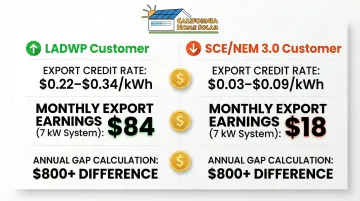
That difference is why LADWP customers can reach 6–9 year payback periods with a solar-only system—no battery required to make the math work.
LADWP Solar Programs: What's Currently Available to LA Homeowners
LADWP Net Metering Program
LADWP's standard net metering interconnection is available to any residential customer with a grid-tied solar system. Here's how the process works:
Eligibility requirements:
- Active LADWP electric account (residential rate schedules R1-A, R1-B, R1-D, or R1-E)
- Solar system located on your property
- System size ≤ 1 MW AC (virtually all residential systems qualify)
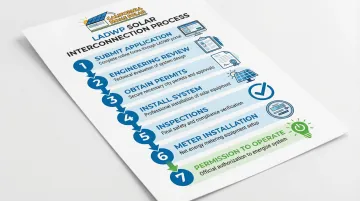
Application steps:
- Submit application through LADWP's Solar Automated Meter Spot (SAMS) portal
- Engineering review — LADWP assigns a Work Request Number and evaluates your system design
- Obtain permits from LA Department of Building and Safety (LADBS)
- Install system — your contractor completes the installation
- Inspections — both LADBS building inspection and LADWP solar inspection are required
- Meter installation — LADWP installs a bidirectional meter to track exports and imports
- Permission to Operate (PTO) — LADWP issues final approval to energize your system
Important program rules:
- Systems under 10 kW without panel upgrades typically qualify for "Fast Track" processing
- An interconnection fee applies, varying by system size and complexity
- Credits use a dollar-value model (not 1:1 kWh exchange)
- Unused credits roll over monthly but are forfeited if you close your account
A local contractor familiar with LADWP's specific requirements can prevent the most common application delays — missed documentation, incorrect system specs, or failed inspections that push your PTO date back by weeks. CA Home Solar manages the full LADWP interconnection process for LA homeowners, from initial application through final PTO approval.
LADWP Solar Rooftops Program
If you can't afford the upfront cost of solar ownership, LADWP offers an alternative: the utility installs and maintains equipment on your roof, and you receive annual payments for hosting the system.
How the program works:
- LADWP installs a 1-10 kW solar system on your property at no cost to you
- LADWP owns, operates, and maintains all equipment
- You receive $360 to $900 per year in lease payments, depending on system size
- Contract term: up to 20 years (total potential value: $7,200 - $18,000)
- Program is currently active and accepting applications
The critical trade-off: Because LADWP owns the equipment, you don't qualify for any ownership-based incentives. This includes:
- Federal Investment Tax Credit (though this expired at the end of 2025 anyway)
- California property tax exclusion
- Depreciation benefits (for commercial properties)
When this makes sense: The Solar Rooftops Program works best for homeowners who:
- Cannot access financing for a purchased system
- Prefer guaranteed annual income over long-term electricity savings
- Don't want responsibility for system maintenance or repairs
- Have suitable roof space but limited capital
When to buy instead: If you can afford to own your system (through cash purchase or financing), you'll see 3-5x greater lifetime savings compared to the Solar Rooftops annual payments. Ownership also positions you to benefit directly as LADWP rates rise — and they have risen steadily over the past decade.
LADWP Rebates and Efficiency Programs
Beyond solar-specific programs, LADWP offers several rebates that can reduce the total cost of a home energy upgrade:
Residential EV Charger Rebate:
- Base rebate: Up to $1,000 for Level 2 (240V) charger purchase and installation
- Dedicated meter bonus: Additional $250 for installing a separate EV meter
- Low-income bonus: Extra $500 for customers enrolled in Lifeline or EZ-SAVE programs
- Total potential: Up to $1,750 for qualifying low-income customers
- Application details
These rebates stack independently of your solar application, so you can pursue them simultaneously without affecting your net metering timeline.
Other efficiency rebates:
- Smart thermostats: $75 for Energy Star models
- Heat pump water heaters: $1,500 - $2,500 depending on efficiency
- Heat pump HVAC: $100 - $120 per ton for high-efficiency systems
Stacking solar with other upgrades: CA Home Solar installs solar alongside roofing, windows, and HVAC upgrades — and bundling projects can unlock financing programs unavailable for solar alone. The company is a registered HERO contractor and also works with California First and YGrene, which means more financing paths for qualifying homeowners.
Federal and State Incentives LADWP Customers Can Still Layer On Top
The Federal Solar Tax Credit in 2026—What You Need to Know Now
CRITICAL UPDATE: The financial landscape for solar changed dramatically at the end of 2025.
The 30% Residential Clean Energy Credit (IRC § 25D), commonly called the federal solar Investment Tax Credit (ITC), expired on December 31, 2025. This credit was repealed by Public Law 119-21 (the "One, Big, Beautiful Bill"), enacted July 4, 2025.
What this means for 2026 installations:
- Solar systems placed in service in 2026 or later are not eligible for the 30% federal tax credit
- IRS Form 5695 cannot be used to claim credits for 2026 installations
- Previously eligible costs (panels, inverters, installation labor, permits, battery storage) no longer receive federal subsidies
- This effectively increases the upfront cost of solar by approximately 30% compared to systems installed before January 1, 2026
Verification: Both the IRS and LADWP's own tax credits page confirm that "the federal government has ended most federal tax credits on clean energy-related purchases."
LADWP customers do have one meaningful advantage here: the utility's retail-rate net metering credits still produce faster payback periods than NEM 3.0 utilities. IOU customers now face 10-12 year paybacks even with battery storage, while LADWP customers can still hit 6-9 year returns on solar-only systems through retail-rate export credits.
California State-Level Incentives That Apply to LADWP Customers
Property Tax Exclusion:
California's Active Solar Energy System Property Tax Exclusion prevents your solar installation from triggering a property tax reassessment. Without this exclusion, adding a $20,000-30,000 solar system could increase your annual property taxes by $200-300.
Key details:
- Status: Active through January 1, 2027
- Benefit: Solar equipment value is excluded from property tax calculations
- Eligibility: Applies to new solar installations (not replacements) on properties in all California counties, including LADWP territory
- How to claim: File with your county assessor when the system is installed
- Official program details
SGIP (Self-Generation Incentive Program) for Battery Storage:
Unlike solar panels, battery storage systems may still qualify for state incentives through SGIP. However, LADWP customers face significant restrictions.
LADWP customers can access SGIP only through the Residential Solar and Storage Equity (RSSE) budget — a low-income pathway that requires household income at or below 80% of Area Median Income. General SGIP budgets are reserved for PG&E, SCE, and SDG&E customers. No equivalent battery rebate exists for general-market LADWP customers.
Verification: LADWP's SGIP FAQ confirms that general SGIP participation is not available to LADWP customers outside the low-income RSSE program.
DAC-SASH (Disadvantaged Communities Single-Family Affordable Solar Homes):
This program offers substantial upfront rebates for qualifying low-income homeowners in disadvantaged communities.
Program structure:
- Incentive: $3 per watt, up to $15,000 for 5 kW systems
- Administrator: GRID Alternatives
- Income requirement: Varies by household size and county
LADWP eligibility: LADWP territory homeowners are not eligible for DAC-SASH. DAC-SASH eligibility requirements explicitly state applicants "Must receive electrical service from Pacific Gas & Electric (PG&E), Southern California Edison (SCE), or San Diego Gas & Electric (SDG&E)."
The incentive gap: LADWP customers miss out on both general SGIP battery rebates and DAC-SASH solar grants available to low-income IOU customers. If you are a low-income LADWP customer, the RSSE program is your primary state-level pathway — contact GRID Alternatives or your installer to check current RSSE availability and income thresholds.
What Your Total Savings Could Look Like: Stacking Incentives as an LADWP Customer
The numbers below show what LADWP customers can realistically expect in 2026 — with the federal tax credit expired, the math depends entirely on net metering value and available state programs.
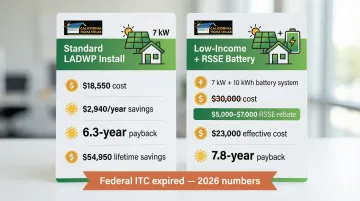
Scenario 1: Standard LADWP Residential Installation
System specifications:
- Size: 7 kW system
- Installed cost: $18,550 ($2.65/watt, based on current market averages)
- Annual production: 10,500 kWh
- Monthly household consumption: 850 kWh
Annual savings calculation:
- Self-consumption: 70% of production (7,350 kWh) × $0.28/kWh average = $2,058
- Grid exports: 30% of production (3,150 kWh) × $0.28/kWh credit = $882
- Total annual bill savings: $2,940
Incentives applied:
- Federal ITC: $0 (expired)
- Property tax exclusion value: ~$250/year for 25 years = $6,250 present value
- Effective system cost: $18,550 (no federal subsidy available)
Payback period: $18,550 ÷ $2,940/year = 6.3 years
25-year lifetime savings: ($2,940/year × 25 years) - $18,550 = $54,950
(Assumes 3% annual electricity rate inflation; actual savings typically run higher when rate increases exceed 3% annually)
Scenario 2: Low-Income LADWP Customer with RSSE Battery Incentive
System specifications:
- Size: 7 kW solar + 10 kWh battery
- Installed cost: $30,000 (solar + storage)
- Qualifies for SGIP RSSE (low-income, LADWP territory)
Incentives applied:
- Federal ITC: $0 (expired)
- SGIP RSSE battery rebate: ~$5,000-7,000 (varies by availability)
- Property tax exclusion: ~$400/year value = $10,000 present value
- Effective system cost: ~$23,000
Annual savings:
- Solar bill reduction: $2,940 (same as Scenario 1)
- Battery backup: energy resilience during outages
- Total annual savings: $2,940
Payback period: $23,000 ÷ $2,940/year = 7.8 years
Even without the 30% federal tax credit, LADWP customers reach payback 2-3 years faster than comparable installations in NEM 3.0 territories. The gap comes down to export credit rates:
| Territory | Export Credit Rate | Annual Savings (7 kW) | Payback Period |
|---|---|---|---|
| LADWP | $0.22–$0.34/kWh | ~$2,940 | ~6–8 years |
| SCE (NEM 3.0) | $0.03–$0.09/kWh | ~$1,200–$1,500 | ~12–15 years |
That's a meaningful difference for homeowners deciding where to install — and why LADWP territory remains one of the strongest markets for solar in California.
Solar for LA Renters and Those Without a Suitable Roof: LADWP Shared Solar
Not every Los Angeles resident can install rooftop solar. Renters, condo owners, and homeowners with shaded or structurally unsuitable roofs have historically been excluded from solar savings. LADWP's Shared Solar program opens that door.
How Shared Solar Works
Program structure:
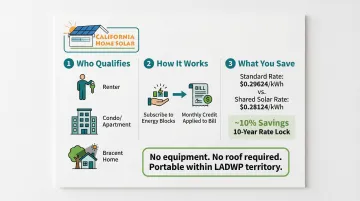
- Subscribe to blocks of solar energy (50-100 kWh increments) from community solar plants
- No equipment installed on your property
- No roof ownership or suitable orientation required
- Renters and homeowners equally eligible
- Subscriptions are portable—move to a new address within LADWP territory and keep your subscription
2026 pricing:
- Standard residential rate: $0.29624/kWh
- Shared Solar discount rate: $0.28124/kWh
- Savings: approximately 10% below standard Tier 1 rates
- Rate lock: 10 years at the discount rate
Bill credit mechanics:
- Each month, your subscribed solar production generates a credit at the discount rate
- Credit is applied to your regular LADWP bill
- You still pay standard rates for consumption above your subscription amount
Is Shared Solar Worth It?
When it makes sense:
- You rent your home and can't install rooftop panels
- Your roof is shaded, faces the wrong direction, or needs structural repairs
- You can't afford the upfront cost of ownership (even with financing)
- You want solar savings without maintenance responsibilities
- You value price certainty over the next 10 years
A typical apartment renter using 600 kWh/month could subscribe to a 500 kWh/month block. At the 10% discount, that comes to roughly $15-18/month in savings — $1,800-2,160 over the 10-year rate lock with zero upfront investment.
Limitations compared to rooftop ownership:
- Total lifetime savings are much lower — thousands rather than tens of thousands
- No ownership equity or property value increase
- Savings are capped at your subscription amount
- Program capacity is limited; waitlists currently exist
The program is active but capacity-constrained. Check LADWP's Shared Solar page for current enrollment windows and waitlist information.
Frequently Asked Questions
Does LADWP use net metering?
Yes. As a municipal utility, LADWP was not required to adopt NEM 3.0 — the policy that slashed export credits for PG&E, SCE, and SDG&E customers. LADWP continues to credit excess solar production at near-retail rates, typically $0.22–$0.34/kWh. See LADWP's net metering guidelines for current program details.
How much does LADWP pay for solar?
LADWP credits solar exports at full retail rates through its net metering program—currently $0.22 to $0.34 per kWh depending on your rate tier and season. This is 3-5 times higher than the $0.03-0.09/kWh that NEM 3.0 customers receive. Alternatively, LADWP's Solar Rooftops Program pays homeowners $360-900 annually to host utility-owned equipment on their roof for up to 20 years.
Is net metering going away in California?
For SCE, PG&E, and SDG&E customers, traditional net metering already ended when NEM 3.0 took effect in April 2023, cutting export compensation by 75–85%. LADWP customers are unaffected — as a municipally owned utility not regulated by the CPUC, LADWP maintains its own retail-rate credit policy with no indication of adopting similar restrictions.
What is the California solar tax credit for 2026?
California has no separate state solar tax credit, and the 30% federal Investment Tax Credit (IRC § 25D) expired December 31, 2025. The main tax benefit remaining is California's Active Solar Energy System Property Tax Exclusion, which prevents installations from increasing your assessed property value — active through January 1, 2027.
Is LADWP shared solar worth it?
Shared Solar is the best option for renters and homeowners with unsuitable roofs — it delivers a 10% discount for 10 years with zero upfront cost and full portability within LADWP territory. That said, total savings ($1,800–$2,200 over 10 years) fall far short of owning a rooftop system, which typically yields $40,000–$60,000 over 25 years.
Can you really get free solar panels in California?
Truly free solar is rare for LADWP customers. The DAC-SASH program (up to $15,000 in rebates) applies only to PG&E, SCE, and SDG&E territories — LADWP residents are not eligible. Income-qualified LADWP customers may qualify for low-income SGIP battery rebates; contact GRID Alternatives to explore current options.
Ready to explore your LADWP solar options? CA Home Solar has been serving Los Angeles homeowners for 36 years, managing LADWP interconnection applications, inspections, and permission to operate on your behalf. Contact us at 877-903-1012 or info@cahomesolar.com for a free consultation and savings estimate based on your property and usage.