in 2026: How California Homeowners Claim the Full 30%](https://file-host.link/website/cahomesolar-9sr760/assets/blog-images/b6330879-793a-4b5f-a719-1347aeb9dd9f/1771945120669573_b36287403f39415288eab133c23aba8f/360.webp)
Introduction
Many California homeowners are racing to go solar before a critical federal deadline — but widespread confusion about the timeline is causing some to miss out entirely. The federal solar tax credit remains at 30% in 2026, yet recent legislation has introduced a hard cutoff date that most online guides fail to explain clearly. Homeowners who don't understand the distinction between residential and commercial tax credits risk losing thousands of dollars in savings.
According to the 2025 SGIP Handbook, California residential battery storage incentives average $150 per kWh, stacking on top of the federal credit. Only homeowners who act before the residential deadline can capture both benefits.
This guide covers what the federal Investment Tax Credit (ITC) is, who qualifies, and what costs are eligible. It also walks through claiming the full 30% using IRS Form 5695 and how California-specific programs like SGIP and the property tax exclusion can maximize your total savings.
TLDR
- The federal solar tax credit holds at 30% — but only for systems installed by December 31, 2025.
- It's a dollar-for-dollar reduction in federal income taxes, not a rebate — unused amounts carry forward.
- Eligible costs cover panels, inverters, mounting hardware, labor, and battery storage (3 kWh minimum).
- Stack the federal ITC with California's SGIP battery rebates and automatic property tax exclusion.
- Claim the credit by filing IRS Form 5695 (Part I) with your tax return for the installation year.
What Is the Federal Solar Tax Credit — and What's Changed for 2026?
The federal solar tax credit, formally known as the Residential Clean Energy Credit (Section 25D), is a dollar-for-dollar reduction in federal income taxes equal to 30% of your total qualifying solar installation cost. It's not a deduction that lowers taxable income, and it's not a rebate you redeem at purchase — it directly offsets the federal taxes you owe, dollar for dollar.
The 30% Rate Through 2032 — With a Critical 2025 Cutoff
The Inflation Reduction Act of 2022 locked the 30% rate through 2032 for residential solar installations. However, the IRS issued guidance in 2025 confirming that residential homeowners cannot claim the credit for expenditures made after December 31, 2025.
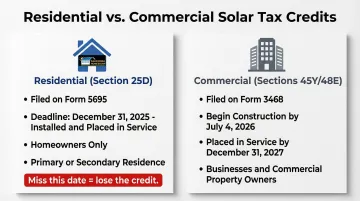
The commonly cited July 4, 2026 "begin construction" deadline and December 31, 2027 "placed in service" deadline apply only to commercial credits (Sections 45Y and 48E), not the residential Section 25D credit homeowners file on Form 5695. California homeowners must have their solar systems installed and capable of producing power by the end of 2025 to claim the 30% credit on their 2025 tax return.
Residential vs. Commercial Credits: Know the Difference
The residential ITC (Section 25D) is filed by homeowners using IRS Form 5695. The commercial Clean Electricity Investment Credit (Section 48E) is filed on Form 3468 by businesses and commercial property owners. This blog focuses exclusively on the residential credit for California homeowners installing solar on primary or secondary residences.
California Has No State Solar Income Tax Credit
Understanding what the residential credit does not cover is just as important. California does not offer a state-level income tax credit for residential solar installations — the California Franchise Tax Board confirms no such credit exists.
When homeowners search "California solar tax credit," they're typically referring to the federal ITC paired with state-specific incentives. Those include the property tax exclusion and SGIP battery rebates — not a separate California state income tax credit.
What the 30% Credit Means in Real Dollars
For the Los Angeles/Southern California market in 2024–2025, the median installed cost is approximately $4.15 per watt for residential systems. Here's what that looks like for a typical installation:
- System size: 7 kW
- Installed cost: ~$29,050
- 30% federal ITC: $8,715 back on your taxes
- Net cost after credit: ~$20,335
That $8,715 comes directly off your federal tax bill — not as a refund, but as a credit against what you owe.
Who Qualifies for the Federal Solar Tax Credit?
Not every California homeowner with solar panels qualifies for the credit. The IRS has specific eligibility requirements.
Core Eligibility Requirements
To claim the residential ITC, you must meet all four criteria:
- You own the solar system outright (leased systems and PPAs do not qualify)
- The system is installed on a U.S. primary or secondary residence (vacation homes qualify if you don't rent them out)
- The equipment is new or limited-previously-used (used systems generally don't qualify)
- The system was placed in service during the tax year you're claiming (meaning it's operational)
The Tax Liability Requirement
The credit can only offset federal income taxes you actually owe. If your 2025 tax liability is $5,000 but your solar credit is $8,715, you'll use $5,000 to eliminate your tax bill and the remaining $3,715 carries forward to your 2026 tax return. The IRS allows unlimited carryforward until the credit is fully used.
Leases and PPAs Don't Qualify
If you lease your solar system or enter a PPA, the leasing company owns the equipment and claims the tax credit — not you. When choosing a solar installer, confirm that your contract is a purchase or loan agreement. California Home Solar structures all residential installations as owned systems, so homeowners keep full access to the federal ITC and any state-level incentives.
How to Claim the Federal Solar Tax Credit: Step by Step
You claim the federal solar tax credit on your annual federal tax return using IRS Form 5695. Having the right documentation in order before tax season makes the process much faster.
Step 1: Collect Your Documentation
Before tax season, gather these essential records:
- Itemized final invoice showing separate costs for panels, inverters, battery storage, mounting hardware, electrical components, and labor
- Signed installation contract with project scope and total cost
- System commissioning or permission-to-operate date from your utility
- Local permit records and final inspection approval
California Home Solar and other licensed installers typically prepare these documents as part of project closeout. Confirm you have a complete file before filing your taxes.
Step 2: Calculate Your Eligible Credit Amount
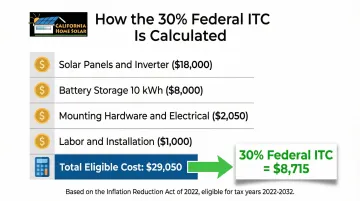
Add up all eligible costs (see "What Solar Costs Count" section below), then multiply the total by 0.30.
Example:
- Solar panels and inverter: $18,000
- Battery storage (10 kWh): $8,000
- Mounting hardware and electrical: $2,050
- Labor and installation: $1,000
- Total eligible costs: $29,050
- 30% federal ITC: $29,050 × 0.30 = $8,715
Step 3: Complete IRS Form 5695, Part I
Download the current Form 5695 and complete Part I (Residential Clean Energy Credit):
- Line 1: Enter total solar electric property costs
- Line 5a: Check "Yes" if battery capacity is at least 3 kWh
- Line 5b: Enter battery storage costs
- Line 6b: Multiply total eligible costs by 30% (0.30)
Part II covers energy-efficient home improvements (windows, insulation, HVAC) — a separate, unrelated credit. Solar panels go on Part I only.
Step 4: Transfer the Credit to Your Form 1040
The credit amount from Form 5695 flows to Schedule 3 (Additional Credits and Payments), Line 5a, then to Form 1040, reducing your total tax liability dollar for dollar.
Step 5: Handle Any Carryforward
If your credit exceeds the tax owed in the filing year, the remaining balance carries forward to the following tax year — note it on your return. If your annual tax liability is well below your expected credit, a tax professional can help you structure your filing to capture the full benefit over multiple years.
What Solar Costs Count Toward the 30% Credit?
Eligible Costs
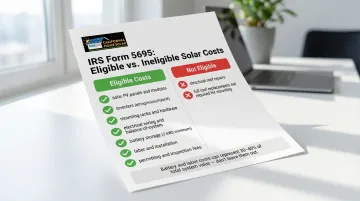
The IRS allows these expenses in your cost basis:
- Solar photovoltaic panels and modules
- Inverters (string, micro, or hybrid)
- Mounting racks and racking hardware
- Electrical wiring and balance-of-system components
- Battery storage systems with capacity of at least 3 kWh (even if added separately after the original installation)
- All labor and installation costs paid to the contractor
- Permitting and inspection fees directly related to the solar installation
What's NOT Eligible
Structural roof repairs or full roof replacements not directly required for mounting the solar system generally don't qualify. Only roofing materials that directly enable the installation may be eligible — a gray area that warrants a conversation with your tax professional.
If roof work is needed before or during your solar installation, a contractor who handles both services can help you document which costs are tied specifically to mounting — a detail that matters when completing Form 5695.
Don't Undercount Your Eligible Costs
Many homeowners forget to include battery storage and labor, which can represent 30-40% of total system value. Adding a 10 kWh battery to a typical California installation can increase the eligible cost basis by $8,000-$10,000, putting $2,400-$3,000 more on your federal tax credit.
California Incentives That Stack with the Federal Credit
Several California programs stack directly on top of the federal ITC — and used together, they can dramatically reduce what you actually pay out of pocket.
California Active Solar Energy System Property Tax Exclusion
When you install solar, California automatically excludes the added home value from property tax reassessment, so your property taxes don't increase because of the solar installation. This exclusion applies to the original owner and currently runs through the end of 2026 under state law (expires January 1, 2027).
Self-Generation Incentive Program (SGIP)
California's primary battery storage rebate offers incentives for residential customers of PG&E, SCE, and SDG&E:
- $150 per kWh base incentive for residential battery storage (Step 7)
- $850 per kWh equity adder for qualifying low-income customers (CARE/FERA)
- $1,000 per kWh equity resiliency adder for low-income customers in high-fire-threat districts or those affected by Public Safety Power Shutoffs
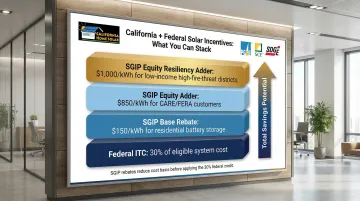
Critical: SGIP rebates must be subtracted from total system cost BEFORE calculating the 30% federal tax credit. The IRS treats incentives as a reduction in your cost basis.
NEM 3.0 Makes Battery Storage Essential for IOU Customers
Homeowners served by SCE, PG&E, and SDG&E who submitted interconnection applications after April 14, 2023, fall under NEM 3.0 (Net Billing Tariff). Under this structure, exported solar energy is compensated at avoided cost rates — typically 5-8 cents/kWh, compared to the 30+ cent retail rates you pay for grid electricity.
That gap makes battery storage financially essential. Storing and self-consuming your solar production avoids selling it back at a loss — and adding a qualifying battery also increases your federal ITC amount.
LADWP customers in Los Angeles still operate under full retail-rate net metering, which means every exported kWh is credited at the retail rate — a significantly better return than the 5-8 cents/kWh IOU customers receive under NEM 3.0. California Home Solar clients in the LADWP service territory can reach the team at 877-903-1012 to discuss how this affects system sizing.
DAC-SASH for Qualifying Low-Income Homeowners
The Disadvantaged Communities – Single-Family Solar Homes (DAC-SASH) program can cover most or all solar installation costs for qualifying low-income homeowners in disadvantaged communities served by PG&E, SCE, or SDG&E. To assess eligibility, Southern California homeowners can contact California Home Solar at 877-903-1012 or visit GRID Alternatives directly.
Common Mistakes That Cost California Homeowners the Full Credit
Avoid these errors that reduce or eliminate your tax credit.
Claiming the Credit on a Leased System or PPA
Homeowners who lease their system or sign a PPA cannot claim the ITC; the leasing company receives it instead. Before signing any solar agreement, ask explicitly: "Will I own this system, or am I leasing it?" California Home Solar offers purchase options with flexible financing, so clients retain ownership and stay eligible for the full credit.
Undercounting the Eligible Cost Basis
Many homeowners and tax preparers unfamiliar with solar forget to include battery storage, labor, electrical upgrades, and inverter costs — resulting in a smaller credit than entitled. Request an itemized invoice from your contractor that clearly separates all eligible components, covering each eligible line item for accurate IRS documentation.
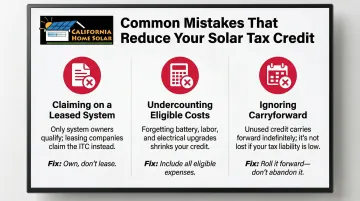
Not Accounting for Carryforward
Homeowners who don't know about the carryforward provision may think the credit is "lost" if their tax liability is too low in the filing year. The credit isn't lost — it carries forward indefinitely until fully used. Most homeowners in this situation absorb the remaining credit over two to three additional tax years, so it's worth factoring into your filing strategy from the start.
Frequently Asked Questions
How do I claim my solar tax credit from the IRS?
File IRS Form 5695 (Part I) with your annual federal tax return for the year the solar system was placed in service. The credit amount flows to Schedule 3, then to Form 1040, reducing your federal tax liability.
What documentation is required for the solar tax credit?
Gather and retain the following for at least three years after filing:
- Contractor's itemized invoice showing all costs
- Signed installation contract
- System commissioning or permission-to-operate date
- Local permit documentation
What credits can I claim on Form 5695?
Form 5695 covers two separate credits, each calculated independently:
- Part I — Residential Clean Energy Credit: solar panels, battery storage, wind, geothermal
- Part II — Energy Efficient Home Improvement Credit: insulation, windows, HVAC
Does California offer a tax credit for solar panels?
No. California does not have a state income tax credit for solar installations. Homeowners benefit from the automatic property tax exclusion, the SGIP battery rebate, and the federal ITC — which is administered at the federal level and available to all eligible U.S. homeowners.
Can the ITC be claimed on solar panels installed in California?
Yes. California homeowners who own (not lease) a qualifying solar system placed in service in the applicable tax year can claim the 30% federal Investment Tax Credit on all eligible costs, including panels, inverters, batteries, and labor.
Is the federal solar tax credit going away?
Under current law, the 30% residential credit applies to systems placed in service through 2032, stepping down to 26% in 2033 and 22% in 2034 before expiring. The July 4, 2026 "begin construction" deadline applies only to commercial projects — not residential installations.
Ready to claim your 30% federal solar tax credit? California Home Solar has helped Southern California homeowners navigate the federal ITC and state incentive programs for 36 years. We manage design, permitting, and commissioning — and provide the itemized documentation your tax preparer needs. Call 877-903-1012 or visit cahomesolar.com for a free consultation.