
Introduction
Many California homeowners living under HOA governance assume their association holds final authority over solar panel installations. The reality surprises most: state law overrides the vast majority of HOA restrictions. While your CC&Rs may contain language prohibiting or limiting solar installations, California's Solar Rights Act renders most of these provisions void and unenforceable.
This tension creates real problems. Some HOAs deny applications outright, unaware they're violating state law. Others impose costly design changes that effectively kill projects. Knowing what your HOA can and cannot legally require is essential before you submit.
This guide covers:
- What the California Solar Rights Act protects
- The specific limits on HOA authority
- How to navigate the approval process without unnecessary conflict or delay
TLDR: Key Takeaways
- California's Solar Rights Act (Civil Code § 714) voids HOA rules that effectively ban or unreasonably restrict solar panels
- HOAs can impose restrictions only if they add less than $1,000 to cost AND reduce efficiency by less than 10%
- Unanswered requests legally count as approval — HOAs must respond in writing within 45 days
- Condo/townhouse owners can install on common area roofs with proper insurance and HOA notice
- Wrongful denials expose HOAs to $1,000 civil penalties plus your attorney's fees
What Is the California Solar Rights Act and What Does It Actually Protect?
The California Solar Rights Act was originally enacted in 1978 under Civil Code § 714 and significantly strengthened by Assembly Bill 2188 in 2014. The stated legislative purpose is clear: "promote and encourage the widespread use of solar energy systems." At nearly 50 years old, it's one of California's most established homeowner protections — and one that has held up repeatedly in court.
What qualifies as a protected "solar energy system":
- Photovoltaic (PV) panels that generate electricity
- Solar water heating systems
- Solar pool heating systems
- Structural design features whose primary purpose is solar collection
Standard rooftop solar panels are squarely covered by these protections.
Under Civil Code § 714, any HOA governing document — including CC&Rs, bylaws, or architectural rules — that "effectively prohibits or restricts" the installation or use of a solar energy system is void and unenforceable under state law. Your HOA does not have the authority to ban solar outright, regardless of what your CC&Rs say.
That protection extends beyond HOAs. Government Code § 65850.5 declares solar energy a "matter of statewide concern," which means local governments cannot impose unreasonable permitting barriers either. For residential rooftop systems under 10 kilowatts, cities must use a **streamlined, non-discretionary permitting process** — meaning approval cannot be withheld through subjective review or lengthy hearings.
What HOAs Can and Cannot Do Under Civil Code Section 714
While HOAs cannot ban solar, they are permitted to impose "reasonable restrictions." The law defines this term precisely through two mathematical thresholds.
The Two-Part Reasonableness Test
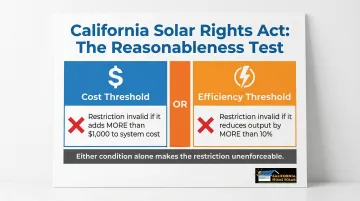
A restriction is unreasonable (and therefore unenforceable) if it results in either:
- Cost increase exceeding $1,000 to your originally proposed system, OR
- Efficiency reduction exceeding 10% from your original design
These are "either/or" conditions, not "both combined." If your HOA requires you to move panels to a less-optimal roof section that costs only $500 but reduces output by 12%, that restriction is invalid under state law.
What HOAs CAN Legally Require
Under Civil Code § 714.1, HOAs may require:
- Prior written approval before installation begins
- Maintenance covenants protecting common areas from damage
- Indemnification agreements holding the association harmless for system-related damage
- Site surveys showing proposed panel placement and roof coverage
These procedural requirements are valid and must be followed.
Aesthetic Restrictions: Where HOAs Have Limited Authority
HOAs can consider aesthetics during architectural review — the California Court of Appeal confirmed this in Tesoro del Valle v. Griffin (2011). However, aesthetic requirements are only valid if they do not exceed the cost and efficiency thresholds.
For example, an HOA can ask you to relocate panels from a front-facing slope to your rear roof, but only if the change:
- Adds less than $1,000 to installation cost, AND
- Reduces system efficiency by less than 10%
If aesthetic changes push beyond either threshold, your original design prevails.
The "Alternative System" Rule
When an HOA restricts your proposed system, these same aesthetic and procedural rules still apply — any alternative must offer comparable cost, efficiency, and energy conservation benefits. The HOA is not required to design this alternative for you. You must resubmit a compliant application showing the alternative meets both thresholds.
How the HOA Approval Process Works: A Step-by-Step Guide
Step 1: Review Your HOA's Governing Documents
Before applying, obtain and review:
- CC&Rs and any solar-specific amendments
- Architectural guidelines and submission requirements
- Required forms and application procedures
Note that any provision outright banning solar is unenforceable, but procedural requirements (like submitting a site plan) remain valid and must be followed.
Step 2: Prepare a Complete Application Package
A strong HOA solar application typically includes:
- Site survey or layout diagram showing exact panel placement, roof coverage percentage, and orientation
- System specifications including panel type, dimensions, output capacity (kW), and inverter details
- Contractor information including license number and insurance certificates
- Building code compliance documentation showing the system meets structural and electrical standards
Incomplete applications are the most common cause of delays — submit a complete package on the first attempt.
Step 3: Submit and Track Your 45-Day Window
Once submitted, your HOA must approve or deny in writing within 45 days. If you receive no written denial within that period, your application is deemed approved by law under Civil Code § 714(e)(2)(B).
Critical submission tips:
- Use trackable delivery (certified mail, email with read receipt)
- Keep copies of everything you submit
- Document the exact date of submission
- Note that the 45-day clock pauses only if the HOA makes a "reasonable request for additional information"
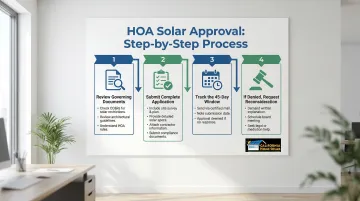
Step 4: If Denied, Request Written Explanation and Reconsideration
If you don't receive a deemed approval, a denial triggers specific obligations. The HOA must provide:
- A written explanation for the denial
- The specific grounds for rejection
- The procedure for board reconsideration
You are entitled to have your denial reconsidered at an open board meeting. This is an important step before escalating to formal dispute resolution.
California Home Solar has navigated HOA approval processes across Southern California for 36 years. Their team helps homeowners submit thorough, well-documented applications that anticipate HOA concerns and cut back-and-forth with the board.
Installing Solar on Common Area Roofs: Special Rules for Condo and Townhouse Owners
Civil Code § 4746 gives condo and townhouse owners the explicit right to install solar on common area roofs (or assigned garages and carports), but with additional requirements beyond single-family homes.
Mandatory Notification and Insurance Requirements
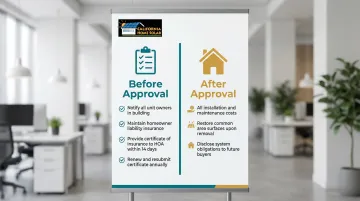
Before the HOA approves your application, you must:
- Notify every unit owner in the building where your system will be installed
- Maintain homeowner liability insurance at all times covering the installation
- Provide a certificate of insurance to the HOA within 14 days of approval
- Renew your certificate of insurance and resubmit it to the HOA each year
Letting your insurance lapse is one of the few conditions an HOA can legitimately enforce — and it can result in a removal order.
Ongoing Owner Responsibilities
Once you clear the approval stage, the obligations shift entirely to you. That includes:
- All costs of installation, maintenance, repair, and eventual removal
- Restoration of common area surfaces if the system is removed
- Disclosure of the system and these obligations to future buyers
Equitable Allocation on Shared Roofs
For buildings where multiple owners may want solar, the HOA can require a site survey showing fair distribution of usable roof space among all interested owners. This prevents one owner from monopolizing prime roof area.
If you're in a multi-unit building, it's worth coordinating with neighbors early — a shared interest in solar can actually strengthen your application and simplify the site survey process.
What to Do If Your HOA Denies or Delays Your Solar Application
Formal Reconsideration Path
If denied, immediately request reconsideration before the full board at an open meeting. Present your case with:
- Documentation showing your system meets the cost and efficiency thresholds
- Contractor specifications confirming compliance with building codes
- Evidence that your design is reasonable and minimally intrusive
Statutory Penalties for HOA Non-Compliance
If your HOA willfully violates the Solar Rights Act by denying a compliant application or delaying beyond 45 days without justification, they face:
- Civil penalty up to $1,000 under Civil Code § 714(f)
- Your actual damages from the delay
- Your reasonable attorney's fees if you prevail in legal action under § 714(g)
That fee-shifting provision matters: HOAs take on real financial liability when they wrongfully deny a compliant solar application.
Pre-Litigation Dispute Resolution
Before filing a lawsuit, California law requires you to attempt:
- Internal Dispute Resolution (IDR) — a direct "meet and confer" meeting with your board, usually informal and low-cost
- Alternative Dispute Resolution (ADR) — mediation or arbitration under Civil Code §§ 5925–5965, typically faster and cheaper than court
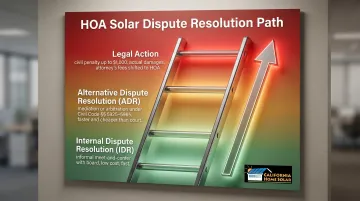
Both options resolve most disputes without litigation — document every communication either way.
Legal Precedents in Your Favor
If IDR and ADR don't resolve the issue, case law gives you a strong foundation. California courts consistently side with homeowners when HOAs cross statutory limits:
- Tesoro del Valle v. Griffin (2011) — confirmed HOAs can consider aesthetics, but only within the cost/efficiency limits
- Palos Verdes Homes Association v. Rodman (1986) — established that HOAs can regulate how solar is installed, but cannot effectively prohibit it
If your HOA appears to be willfully violating the law, consult an attorney experienced in HOA and solar rights disputes.
Frequently Asked Questions
Can an HOA deny solar panels in California?
No. HOAs cannot outright deny or prohibit solar panels under Civil Code § 714. They can only impose reasonable restrictions that don't add more than $1,000 to cost or reduce efficiency by more than 10%. Any CC&R provision that effectively bans solar is void and unenforceable.
What is the new California law on solar panels?
The Solar Rights Act dates to 1978 and was strengthened in 2014. California now mandates solar on all new residential construction — single-family homes since 2020, multifamily buildings since 2023. The 2025 landscape also includes AB 130 (capping HOA fines at $100) and ongoing net metering changes under NEM 3.0.
Can a neighbor's trees block my solar panels?
The Solar Shade Control Act (Public Resources Code §§ 25980–25986) protects your solar system from shading by trees or shrubs planted after your installation. Neighbors cannot allow vegetation to cast shadows covering more than 10% of your panels between 10 a.m. and 2 p.m. Trees planted before your installation are exempt.
What is the solar mandate in California 2025?
California requires solar on all new residential construction — single-family homes since 2020 and multifamily buildings since 2023. This mandate applies only to new construction, not existing homes. The Solar Rights Act separately protects your right to add solar to existing homes regardless of HOA restrictions.
Is it hard to get approved for solar panels?
Approval difficulty varies by HOA, but most concerns come down to aesthetics or placement. Submit a complete application with site plans and specifications, and HOAs typically approve within the 45-day window. Working with an experienced local installer makes the documentation process much smoother.