Introduction
California homeowners face a unique financial reality: the state's electricity rates average 27.04 cents per kilowatt-hour, more than double the national average, while the Los Angeles metro area's median home price hovers around $807,540. This combination makes solar panels both a practical necessity and a significant investment—but does that investment actually increase your home's resale value?
For sellers and buyers alike, the answer matters—and it's more nuanced than a simple yes or no. Ownership type, system size, and local market conditions all affect the outcome.
This guide covers the data on value premiums, explains how ownership structure changes your sale, and gives you actionable steps for navigating California's solar real estate market.
TLDR
- Solar panels increase California home values by approximately 3-4%, with Los Angeles homes seeing premiums of $29,000 to $55,000
- Owned systems add maximum value; leased systems complicate sales and typically don't increase appraised value
- California's property tax exclusion lets you gain equity without higher property taxes — the exemption runs through January 1, 2027
- Sellers must disclose financing type, provide system documentation, and pay off any PACE/HERO liens before closing
- Buyers should verify ownership, review 12 months of production data, and check remaining warranty coverage
How Much Do Solar Panels Increase Home Value in California?
Research consistently shows that California buyers pay a premium for solar-equipped homes, viewing them as upgraded properties with lower operating costs.
The Premium in Dollar Terms
Zillow research found that solar panels increase home values by approximately 4.1% nationally, with California's statewide premium around 3.6%. 2025 estimates place the premium as high as 6.9% as energy costs continue climbing.
For Los Angeles homeowners, this translates to substantial added value:
- LA Metro median home price: $807,540
- Premium at 3.6%: ~$29,000
- Premium at 6.9%: ~$55,000
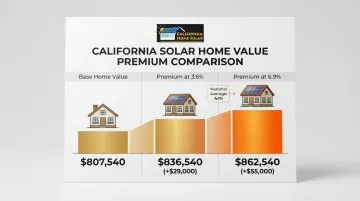
Those dollar figures reflect real buyer demand. What drives that willingness to pay more comes down to projected energy savings over the life of the system.
Why Buyers Pay More: Energy Savings Drive the Premium
Buyers factor in decades of reduced electricity bills, not just the hardware sitting on the roof. With California's average residential rate at 27.04 cents/kWh, a properly sized solar system can eliminate 70–100% of monthly electricity costs.
Appraisers now commonly use the "income approach" to value solar systems, calculating the present value of projected energy savings over the system's remaining life using tools like Sandia National Laboratories' PV Value® calculator. This method links the appraised value to California's high electricity rates—the higher the rates, the more valuable the system.
That appraised value, though, depends heavily on how much energy the system can still produce. A decade-old system performing below its original specs is worth less than a newer one running at full capacity.
System Age and Output Matter
Not all solar systems command the same premium. Solar panels degrade at a median rate of 0.5% per year, meaning a 10-year-old system produces roughly 5% less energy than when new. A newer, properly sized system with documented performance history will command a stronger premium than an aging system with degraded output.
Key factors that affect premium:
- System age and remaining useful life
- Current output capacity versus original specs
- Quality and brand reputation of panels and inverters
- Complete documentation and warranty coverage
- Whether the system is grandfathered under NEM 2.0 (see below)
Why California Is One of the Best States for Solar Home Value
California gives solar homeowners something most states don't: legal protections and policy structures that directly translate into higher resale value. Three specific advantages set California apart.
Property Tax Exclusion: Value Without the Tax Bill
Under California's Active Solar Energy System Exclusion, solar installations don't trigger property tax reassessments. You gain the $29,000-$55,000 home value increase without a corresponding jump in your annual property tax bill. This exclusion is currently active through January 1, 2027.
Mandatory Solar Normalizes the Technology
Since January 1, 2020, California's Title 24 Building Energy Efficiency Standards have required solar PV systems on all newly constructed low-rise residential buildings. This mandate has normalized solar as a standard home feature rather than a luxury upgrade, making buyers far more comfortable purchasing solar homes.
NEM 2.0 Grandfathering Is a Selling Point
Beyond the hardware, the rate agreement attached to an older system can be worth thousands over its lifetime. California's net metering policy changed on April 15, 2023, with the implementation of NEM 3.0 (Net Billing Tariff). New systems receive substantially lower compensation for excess electricity sent back to the grid compared to the previous NEM 2.0 rules.
Critical for sellers: Systems interconnected before April 14, 2023, remain on the more favorable NEM 2.0 tariff for 20 years from their permission-to-operate date. Buyers who purchase a grandfathered home inherit better economics than they could get by installing new solar today — that's a concrete financial advantage worth highlighting in any listing.
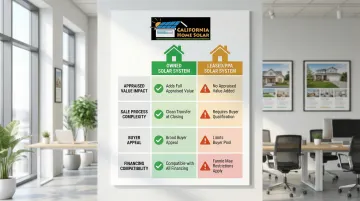
Owned vs. Leased Solar: The Difference That Changes Everything
The single most critical factor in a solar home sale is ownership status. How the system is financed fundamentally affects home value, the sale process, and buyer appeal.
Owned Systems: Maximum Value, Clean Transfer
Cash purchase: Fully paid-off systems transfer with the home like any other fixture. Buyers inherit a free-and-clear asset with no monthly obligations — the simplest path to full appraised value.
Solar loan: If you financed your system with a standard loan secured by you (not the property), you'll typically pay it off from sale proceeds at closing. The system is owned and can be appraised as part of the home's value.
Leased Systems and PPAs: Appraisal Challenges
Systems subject to a lease or Power Purchase Agreement (PPA) are considered personal property, not real estate. Fannie Mae guidelines explicitly state that leased solar panels cannot be included in the appraised value of the home.
Transfer complications:
- Buyer must qualify with the solar company
- Buyer must agree to assume remaining contract terms (often 15-20 years)
- Some buyers will walk away rather than take on lease obligations
- Seller may need to buy out the lease to complete the sale
PACE/HERO Financing: A Special Case
PACE loans (like the HERO program) are attached to the property through the tax assessment, not to the homeowner personally. These create unique complications:
- Super-priority lien status: PACE assessments take precedence over mortgages
- Fannie Mae/Freddie Mac restriction: These agencies will not purchase mortgages secured by properties with outstanding PACE liens
- Typical requirement: Sellers must pay off the full PACE balance at closing for the buyer to obtain conventional financing
- Disclosure: PACE liens appear as line items on property tax bills and must be disclosed upfront
Why Owned Systems Give You the Strongest Sale Position
For California homeowners focused on resale value, owned systems consistently outperform leased ones. A properly permitted, fully documented system is straightforward for appraisers to evaluate and gives buyers confidence in what they're taking on.
Contractors like California Home Solar — serving Southern California for 36 years and recognized as a Top 500 Solar Contractor — emphasize ownership-based installation precisely because it protects the homeowner's equity position at sale.
What Sellers with Solar Panels Need to Know
Getting full value from your solar system at sale comes down to paperwork, disclosure, and knowing your financing obligations before the first showing.
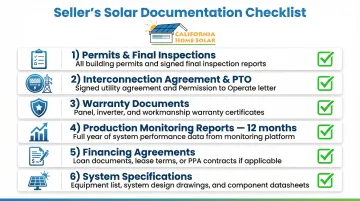
Gather Documentation Before Listing
Organize these critical documents before your home hits the market:
- Permits and final inspections from your local municipality
- Interconnection agreement and Permission to Operate from your utility
- Warranty documents for panels, inverters, and installation
- Production monitoring reports showing at least 12 months of historical output
- Financing agreements (loan documents, PACE statements, or lease contracts)
- System specifications (size in kW, panel/inverter models, installation date)
Disclose Everything Upfront
California law requires disclosure of material facts affecting home value. Solar financing obligations—especially PACE liens or lease agreements—must be disclosed in writing. Transparency prevents deal-killing surprises during escrow and builds buyer confidence.
Understand Your Financing Obligation
Before listing, determine:
- Confirm whether your solar loan will be paid off from sale proceeds or satisfied before closing
- Verify whether a PACE/HERO lien is on your property tax bill — buyers using conventional financing typically require it cleared at close, so factor that payoff into your net proceeds
- Contact your solar company about lease or PPA transfer requirements and whether a buyout makes financial sense before listing
Do Solar Homes Sell Faster?
California data leans positive, though results vary by market. A Department of Energy study found solar homes in California sold 20% faster than comparable non-solar homes. A Lawrence Berkeley National Laboratory study, however, found no consistent difference in days-on-market across multiple states.
In high-awareness markets like Los Angeles, owned systems with clear documentation and a solid production history tend to draw buyers who have already priced in the utility savings — which can accelerate decisions.
Communicate Value Proactively
Many real estate agents lack solar expertise. Prepare a one-page system summary including:
- System size (kW) and annual production (kWh)
- Average monthly utility savings (with before/after bills)
- System age and remaining warranty coverage
- NEM 2.0 grandfathering status (if applicable)
- Ownership status and absence of liens
This summary helps buyers and their agents understand the tangible financial benefit rather than viewing solar as an unknown complication.
What Buyers Should Know Before Purchasing a Solar Home
A few targeted questions before closing can mean the difference between a valuable asset and an expensive obligation.
Verify Ownership Status First
Before making an offer, confirm whether the system is:
- Owned outright — transfers cleanly at closing
- Financed with a traditional loan — seller pays off at closing
- Subject to a PACE/HERO lien — may require payoff or lender approval
- Leased or under a PPA — you must qualify and assume the contract
If leased, review the remaining contract length, monthly payment, escalation clauses, and transfer conditions. Some buyers choose to walk away rather than assume 15-20 years of lease obligations.
Request Production and Savings Records
Ask for at least 12 months of:
- Utility bills showing actual electricity costs with solar active
- Solar monitoring data showing system output in kWh
- A pre-solar comparison period, if available, to measure real savings
This tells you whether the system delivers real savings — not just promises. A 5 kW system may be undersized if the home uses 1,200 kWh per month but the system only produces 600 kWh.
System age matters just as much as current output. An older system may be producing fine today but facing imminent hardware costs.
Factor in System Age and Warranty Coverage
Check both panel and inverter warranties before finalizing your offer:
- Panels: The industry standard is 25 years, covering defects and output (typically guaranteeing 80–92% of original production at year 25)
- Microinverters (such as Enphase): Often carry 25-year warranties
- String inverters (such as SolarEdge or Fronius): Typically 10–12 years, sometimes extendable to 20–25 years
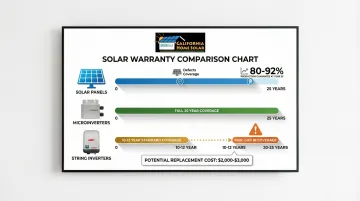
A 10-year-old system with original string inverters may need inverter replacement within 2–5 years — a cost of $2,000–$3,000 or more that should factor into your offer price.
Check NEM Status
If the system was interconnected before April 14, 2023, it qualifies as grandfathered under NEM 2.0 for 20 years from the permission-to-operate date (the date the utility approved the system to connect to the grid). Verify this with the interconnection agreement — NEM 2.0 status means significantly better export rates than NEM 3.0.
Frequently Asked Questions
How much does solar increase home value in California?
Solar panels typically increase California home values by 3-6.9%, with Los Angeles metro area homes seeing premiums of approximately $29,000 to $55,000. Owned systems command stronger premiums than leased systems, which often add no appraised value.
Is it harder to sell a house with solar panels?
Owned solar systems typically make homes easier and faster to sell in California's high-electricity-cost market. Leased systems can add complexity because buyers must qualify to assume the lease. A fully documented owned system is a genuine selling advantage.
How do solar panels work when you sell your house?
Owned solar transfers with the home at closing like any other fixture. Leased systems require the seller to either buy out the lease, transfer it to the buyer (pending solar company approval), or in rare cases relocate the panels.
What happens to my solar loan if I sell my house?
Traditional solar loans (secured by the homeowner) are typically paid off from sale proceeds at closing. PACE/HERO loans tied to the property tax bill must be disclosed and often require payoff before buyers can obtain conventional financing.
Are solar panels exempt from property taxes in California?
Yes, California's Active Solar Energy System Exclusion prevents solar installations from triggering property tax reassessments. This exclusion is currently active through January 1, 2027, meaning you gain home value without increased property taxes.
Do buyers actually pay more for homes with solar panels in California?
Yes. Zillow research confirms California buyers pay a measurable premium for solar homes, particularly in high-electricity-cost markets like Los Angeles. The main driver is anticipated energy savings — buyers factor in years of lower utility bills when deciding what to offer.