Introduction
Most California homeowners expect the solar + EV charger combination to be straightforward. It isn't. These are two separate systems with distinct permitting, electrical, and utility requirements—and coordinating them poorly can cost you thousands in rework, delays, or lost credits.
The most common mistakes happen when homeowners undersize their solar array to accommodate EV demand, fail to upgrade electrical panels before adding a 40–60A charger circuit, or encounter utility interconnection delays that stall the entire project. Under California's NEM 3.0 rules, which slashed export credits by roughly 75%, these missteps are more costly than ever.
This guide walks you through every phase—from pre-installation planning to post-installation validation—so you can execute the setup correctly the first time and maximize both your solar investment and EV charging efficiency.
TL;DR
- Size your system, assess your panel capacity, and understand NEM 3.0 interconnection rules before you start
- Choose a Level 2 (240V) charger—Level 1 is too slow for daily use, and DC Fast Charging isn't compatible with residential panels
- Budget for 7–12 extra solar panels on top of your home's baseline needs to cover EV charging
- Under NEM 3.0, self-consumption beats grid export, so pairing solar with EV charging helps you use more of what you generate
- Secure permits for both solar and EV charger installations to avoid legal, insurance, and resale complications
Before You Start: Prerequisites and Planning for a California Solar + EV Charger Setup
A solar + EV charger setup is two interconnected projects that must be designed together from day one. Retrofitting an EV charger onto an underpowered solar system is the most common and costly mistake California homeowners make.
Roof and Solar Suitability
Your installer must assess:
- Available roof space and orientation — South-facing roofs are optimal in Southern California for maximum sun exposure
- Shading — Trees, chimneys, or neighboring structures can reduce production by 10–30%
- Roof structural integrity — Older roofs may require replacement before panels are mounted to ensure they can support the racking system for 25+ years
Electrical Panel Capacity
Adding both solar and a Level 2 EV charger (drawing 30–50 amps) frequently requires upgrading from 100A to 200A service. Approximately 30% of California homes still operate on 100A panels, which often can't accommodate the combined load safely.
A licensed electrician must perform a load calculation before any other work proceeds. Without it, you risk tripped breakers, failed inspections, and voided permits — all avoidable with an hour of upfront assessment.
EV Load Sizing
Estimate your annual EV charging demand before sizing your solar system:
- Vehicle efficiency — most EVs consume 0.25–0.35 kWh per mile
- Annual mileage — 12,000 miles at 0.3 kWh/mile equals roughly 3,600 kWh/year
- Total system size — add that EV load to your household baseline consumption
This calculation directly determines how many solar panels you need.
California-Specific Regulatory Checklist
You'll need:
- Solar installation permit (building/electrical permit)
- Electrical permit for the EV charger (separate from solar)
- Utility interconnection agreement with your local utility (SCE, PG&E, or LADWP in the Los Angeles area)
NEM 3.0 governs how excess solar energy is credited for most new installations. Export credits have dropped to $0.03–$0.06/kWh during midday hours, making self-consumption optimization far more important than under the previous NEM 2.0 program.
These utility-specific rules vary across SCE, PG&E, and LADWP territories, which is why local contractor experience matters. California Home Solar has handled permitting and interconnection agreements across Los Angeles County for 36 years, cutting through the paperwork that trips up out-of-area installers.
How to Set Up a Solar + EV Charger System: Step-by-Step
This setup follows a strict sequence — solar cannot be energized before utility approval, and the EV charger must be wired into the correct circuit after any panel work is done. Working out of order causes costly rework and potential compliance issues.
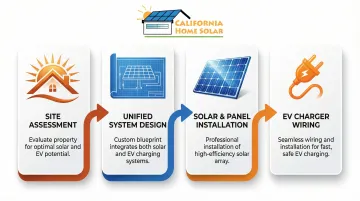
Site Assessment and System Design
A licensed installer conducts a site survey covering:
- Roof condition and sun exposure hours
- Existing electrical load and panel capacity
- Anticipated EV usage patterns
The output is a unified system design specifying panel count, inverter type (string inverter or microinverters depending on roof complexity), EV charger model, and any panel upgrade required. Everything should be designed as a single integrated system, not two separate projects.
Solar Panel and Inverter Installation
The physical installation process includes:
- Mounting the racking system securely to the roof structure
- Installing solar panels and wiring strings to the inverter
- Connecting the inverter to the main electrical panel
In California, all solar work must be performed by a CSLB-licensed contractor (typically C-46 Solar Contractor or C-10 Electrical Contractor) and inspected by the local jurisdiction before the system can be energized.
Once inspection clears the solar installation, the EV charger can be added to the same permitted scope — keeping both systems under a single project timeline.
EV Charger Installation
A Level 2 EVSE (Electric Vehicle Supply Equipment) is hardwired to a dedicated 240V circuit in your garage or carport. Key requirements:
- Size the circuit breaker at 40–60A to match the charger's amperage (NEC's 125% continuous load rule applies)
- Install the charger after any panel upgrade is complete, and inspect before use
- Choose a smart charger with solar-sensing or scheduling features — a practical choice for California homeowners on time-of-use (TOU) rates
Utility Interconnection and Permission to Operate (PTO)
In California, your solar system cannot be turned on until the utility grants Permission to Operate (PTO). This process can take several weeks after installation and inspection:
- SCE: Typically 10 business days after final inspection and document submission
- LADWP: Often 20–45 days, though expedited tracks exist for smaller systems
The EV charger can be used before PTO, but charging will draw from the grid until solar is activated. Skipping the interconnection paperwork disqualifies you from NEM net metering credits — meaning you lose the billing offsets that make solar financially worthwhile.
Post-Installation Testing and Monitoring Setup
Validate that everything works correctly:
- Confirm solar production displays correctly in the monitoring app
- Verify the EV charger communicates with the vehicle and home system
- Check that the panel isn't overloaded under simultaneous EV charging + peak home load
- Review your utility bill after the first full billing cycle to confirm NEM credits apply correctly
How to Choose the Right EV Charger for Your Solar System
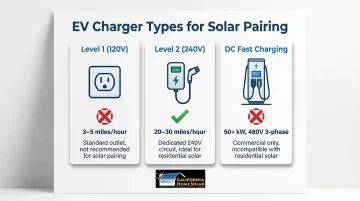
Level 1 vs Level 2 vs DC Fast Charging
Level 1 (120V): Impractically slow for daily EV use when paired with solar—adds only 3–5 miles of range per hour.
Level 2 (240V): The standard for residential solar integration, delivering 20–30 miles of range per hour. This is the correct choice for the vast majority of California homeowners.
DC Fast Charging: Designed for commercial/public use, requiring 480V 3-phase power and drawing 50+ kW—far exceeding typical residential panel capacity (a 200A panel supports ~48 kW total for the entire home). Not compatible with standard residential solar + inverter setups.
Smart Charger Features Worth Prioritizing
Under NEM 3.0, prioritizing charging during peak solar production hours (typically 10 AM–3 PM) rather than evening peak-rate hours directly cuts your grid draw and keeps more of your solar generation working for you.
Look for chargers with:
- Solar-synced charging modes — Wallbox Pulsar Plus, Emporia Level 2, and Enel X JuiceBox all offer settings that automatically align charging with your panels' peak output
- App-based scheduling and remote control — Adjust charge times from your phone when production forecasts or your plans change
- Home energy management compatibility — Works with whole-home monitoring platforms to optimize total household energy use
Key Compatibility Checks Before Purchasing
Confirm:
- Circuit sizing is correct — A 48A charger requires a dedicated 60A breaker; confirm with your electrician before purchasing
- UL or ETL certification — California permit approval requires this listing; uncertified chargers won't pass inspection
- Connector compatibility — J1772 works for all non-Tesla vehicles; Tesla owners use NACS but can accept J1772 with an adapter
Common Solar + EV Charger Setup Problems (and How to Fix Them)
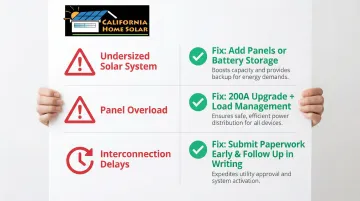
Most problems arise from incomplete planning, not from the technology itself. Skip a load calculation or delay your interconnection paperwork, and you're looking at tripped breakers, stalled permits, or a solar system that can't keep pace with your EV. These three issues drive the majority of callbacks and rework in California residential installations.
Undersized Solar System That Can't Keep Up with EV Demand
You install solar first, buy an EV a year later, and suddenly your net-metering credits aren't covering the bill. The system was sized for your household baseline—not for the 30–40 kWh your car needs each week.
This is the most common sizing mismatch in California, and it's almost always preventable with upfront planning.
To fix it:
- Have a licensed installer assess whether additional panels fit your existing system and inverter capacity
- If expansion isn't possible, add a battery storage system to buffer daytime solar for nighttime charging
- Adjust your charging schedule to peak solar hours as an interim measure
Electrical Panel Overload After EV Charger Is Added
Breakers start tripping the moment your EV charger runs at the same time as the HVAC, oven, or dryer. A 40–50A charger added to a 100A panel often pushes total demand past what the panel can handle.
The fix has two parts:
- A licensed electrician performs a load calculation and upgrades the panel to 200A service
- Smart load management devices prevent simultaneous peak draw across high-demand circuits
Don't skip the load calculation—it's what tells you whether a panel upgrade is actually necessary or whether load management alone will do the job.
Utility Interconnection Delays Stalling the Whole Project
The panels are on the roof, the charger is wired in—but you can't turn anything on. No Permission to Operate (PTO) means no net-metering credits and no legal activation, sometimes for weeks or months.
In the LA area, LADWP and SCE backlogs are a known issue, but incomplete applications make delays much worse.
To avoid getting stuck:
- Confirm your installer submits interconnection paperwork alongside permit applications—not after installation wraps up
- Request estimated PTO timelines from your utility in writing
- Follow up proactively rather than waiting; utilities respond faster to documented requests
Pro Tips for Getting the Most From Solar + EV Charging in California
Time-of-Use Rate Strategy
Most California utilities (SCE, LADWP, PG&E) use TOU pricing where electricity costs significantly more during evening peak windows:
- SCE (TOU-D-PRIME): Peak window is 4:00 PM–9:00 PM, with rates spiking to ~$0.50/kWh or more during summer
- LADWP (R-1B): High peak window is 1:00 PM–5:00 PM, with lowest "Base" rates from 8:00 PM–10:00 AM and all day weekends
Program your EV charger to charge during midday solar production hours or off-peak overnight hours. This combination of solar self-consumption during the day and off-peak grid charging at night can save California homeowners hundreds of dollars annually — savings that compound as utility rates rise. That's where battery storage comes in.
Consider Adding Battery Storage to Complete the System
Under NEM 3.0, excess solar exported to the grid earns very low credit rates ($0.03–$0.06/kWh during midday). A home battery can store that midday solar surplus and dispatch it for EV charging or home use during the expensive 4–9 PM peak window — recapturing value that would otherwise be lost to low export rates.
Two common options for Southern California homeowners:
- Tesla Powerwall 3 — starts at $11,959; best for whole-home backup and high EV charging demand
- Enphase IQ Battery 5P — approx. $3,800–$4,000 per 5 kWh unit; modular if you want to start smaller
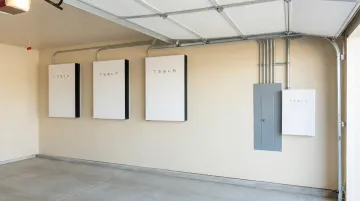
Batteries add upfront cost, but this load-shifting approach often improves overall ROI under NEM 3.0 compared to exporting surplus solar at low grid rates.
Document Everything and Keep Permits on File
Retain all permits, inspection records, interconnection agreements, and equipment warranties in one file. These documents are required for:
- Utility NEM enrollment
- Insurance claims
- Home sale transactions
Home inspectors frequently flag unpermitted EV charger installations during California home sales, and the fallout can delay or kill transactions entirely.
Frequently Asked Questions
Can I charge my EV directly from solar panels?
Yes, solar panels can power EV charging indirectly through your home's electrical system. The panels feed power to your inverter and electrical panel, which then powers the EV charger. Direct DC charging from panels to vehicle isn't practical in standard residential setups.
How many solar panels would I need to charge my electric car?
It depends on your EV's efficiency, annual mileage, and panel wattage. Driving 12,000 miles/year at 0.3 kWh/mile needs ~3,600 kWh annually—roughly 6 additional 400W panels in Southern California. Most homeowners add 7–12 panels to account for system losses and weather variability.
Are solar EV chargers worth it?
Yes. Charging with rooftop solar locks in a fuel cost equivalent to roughly $1.00–$1.50 per gallon of gasoline. A typical Southern California homeowner saves $1,200–$2,300 annually compared to buying grid power and gas—and under NEM 3.0, using more self-generated power shortens your payback period.
What EV chargers work with solar panels?
Any Level 2 (240V) EVSE works with a solar system—the charger draws from your electrical panel, which solar feeds into. That said, smart chargers with solar-sensing or scheduling features (Wallbox Pulsar Plus, Emporia Level 2, Enel X JuiceBox) are better suited to maximize self-consumption under NEM 3.0.
What is the new solar law in California?
NEM 3.0 took effect in April 2023 for new solar applicants, cutting grid export compensation by roughly 75%. This makes self-consumption strategies—like charging your EV during peak solar hours—far more valuable than under NEM 2.0. It applies to SCE, PG&E, and SDG&E customers; municipal utilities like LADWP operate under separate rules.
What is the 33% rule in solar panels?
This guideline suggests a solar system should not produce more than 33% excess electricity beyond the home's annual consumption. Under NEM 2.0, utilities often streamlined approval for systems sized up to 133% of historical annual usage. Under NEM 3.0, there's no hard cap preventing larger systems, but you must justify the load (e.g., "I purchased an EV"). Oversizing without justification may trigger additional utility review or different interconnection requirements.