Introduction
The commercial roof protecting your business represents one of your largest capital investments — yet many property owners choose a system based on habit or upfront cost alone, without evaluating what each option actually delivers long-term. In Southern California's intense sun and heat, this oversight can prove costly.
That cost shows up in more ways than one. Roof slope, climate, building use, and energy goals all influence which system performs best — and commercial roofing is far from one-size-fits-all. A membrane that excels in cooler climates may absorb excessive heat in Los Angeles, inflating cooling costs and cutting years off the roof's life.
This guide breaks down the main commercial roofing system types, compares their performance characteristics, and highlights what matters most when choosing the right system for a Southern California property.
TLDR
- Commercial roofing systems protect flat or low-slope buildings from water intrusion, heat, and structural stress
- Common types include TPO, EPDM, Modified Bitumen, Built-Up Roofing (BUR), and Metal — each suited to different needs and budgets
- In Southern California's hot, high-UV climate, TPO and metal roofing lead on energy efficiency and heat reflectivity
- The best system depends on roof pitch, building use, foot traffic, budget, and maintenance capacity
- Work with a licensed contractor familiar with California's Title 24 cool roof compliance requirements
What Are Commercial Roofing Systems?
A commercial roofing system is the complete assembly of materials — membrane or surface layer, insulation, cover board, and deck — installed to protect a commercial building from weather, temperature extremes, and moisture intrusion.
The key distinction between commercial and residential roofing: most commercial buildings use flat or low-slope roofs with a pitch of ¼:12 to 3:12. These require entirely different materials and installation techniques than pitched residential shingles.
Commercial roofing systems fall into three broad categories:
- By material: TPO, EPDM, modified bitumen, metal
- By installation method: torch-down, mechanically fastened, fully adhered
- By structure: flat, low-slope, standing seam
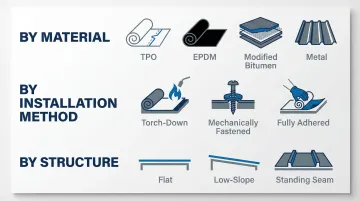
Most contractors and building owners categorize systems by material — which is the approach this guide uses.
Why Your Commercial Roofing System Matters
A failing or mismatched roofing system leads to cascading problems: water intrusion, mold, structural damage, lost inventory, and voided warranties. Roofing selection is a risk management decision, not just a construction one.
The consequences show up in multiple areas:
- Property damage: Leaks accelerate structural deterioration and can halt operations
- Insurance exposure: Many policies exclude damage from neglected or non-compliant systems
- Energy waste: A mismatched roof drives up cooling loads year-round
In Southern California, a poorly chosen roof drives cooling costs up fast. The right reflective or insulated system reduces energy consumption per California Title 24 cool roof requirements, lowering utility bills across the roof's lifespan. With the 2025 Title 24 standards now in effect, most reroofing projects must comply.
Types of Commercial Roofing Systems
Commercial roofing systems are not interchangeable. Each type is engineered for specific roof designs, climates, budgets, and performance expectations. Knowing which system fits your building comes down to a handful of factors: roof slope, local climate, energy code requirements, foot traffic, and long-term budget.
The five systems covered here represent the most widely installed options for flat and low-slope commercial buildings. The best choice depends on a combination of those factors working together — no single system wins across every category.
TPO (Thermoplastic Polyolefin) Roofing
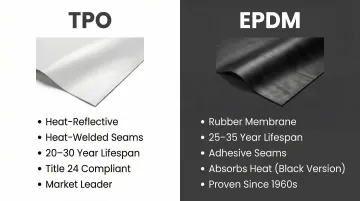
TPO is a single-ply white or light-colored thermoplastic membrane installed in large rolls over flat or low-slope commercial roofs. Seams are heat-welded together to form a watertight bond, and it can be mechanically fastened, fully adhered, or ballasted.
Key Strengths:
- Reflects solar heat rather than absorbing it, making it a strong performer for energy efficiency in hot climates like Los Angeles
- Resistant to mold, punctures, and chemical exposure
- Market leader commanding approximately 37% of the single-ply market
- Rated lifespan of 20–30 years depending on membrane thickness
- Inherently meets Title 24 cool roof standards with aged Solar Reflectance of 0.73–0.80 and SRI of 78–84
Limitations:
- Shorter long-term track record than EPDM or BUR
- Quality varies significantly by manufacturer
- Improper heat welding during installation creates leak-prone seam failures
- Less suited for buildings with heavy rooftop equipment and frequent foot traffic
EPDM (Ethylene Propylene Diene Monomer) Roofing
EPDM is a durable synthetic rubber membrane (commonly called "rubber roofing") available in black or white sheets. It's installed on flat or low-slope roofs via mechanical fastening, full adhesion, or ballasting. EPDM has been in widespread commercial use since the 1960s.
Key Strengths:
- Proven service life of 25–35 years, with some systems performing for over 40 years
- Strong resistance to UV radiation, ozone, and temperature fluctuations
- Flexibility allows the membrane to absorb building movement without cracking at seams
- Cost-effective option for larger roof surfaces
Limitations:
- Traditional black EPDM absorbs heat rather than reflecting it, making it less energy-efficient in Southern California's climate
- White/reflective versions are available but represent a specialized product
- Seams are adhered with tape or adhesive rather than welded, which can be a long-term vulnerability if not maintained properly
Modified Bitumen Roofing
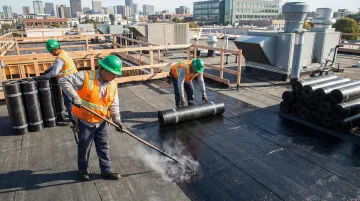
Modified Bitumen (Mod Bit) is an asphalt-based system reinforced with polyester or fiberglass and modified with rubber (SBS) or plastic (APP) polymers for added flexibility and strength. Installation follows a multi-layer approach (base sheet, membrane, and surfacing) and can be completed by torch application, hot mopping, cold adhesive, or self-adhered methods.
Key Strengths:
- Multi-ply layered construction provides excellent redundancy (if one layer is compromised, others maintain protection)
- Performs well against heavy rain, foot traffic, and UV exposure
- Decades-long proven performance record, especially on flat commercial roofs with mechanical equipment
- Typical lifespan of 20–30 years
Limitations:
- Torch-down installation carries fire risk during application and requires experienced installers with CERTA certification
- Dark surfacing on standard versions absorbs heat, though granule-surfaced or reflective cap sheets are available
- Requires periodic inspections and recoating to maintain waterproofing integrity over time
- Does not meet Title 24 standards without reflective cap sheets or field-applied cool coatings
Built-Up Roofing (BUR)
BUR is one of the oldest and most proven commercial flat roofing systems, composed of alternating layers ("plies") of bitumen-saturated felt or fiberglass mats and hot asphalt, topped with a protective surfacing of gravel, mineral cap sheet, or reflective coating. Most commercial projects specify a four-ply system as standard.
Key Strengths:
- Redundant multi-layer construction makes it extremely durable and resistant to leaks, punctures, and foot traffic
- Superior Class A fire resistance from external flames
- Long, well-documented performance history with typical lifespan of 20–30 years
- Gravel surfacing provides ballast and additional UV protection
Limitations:
- One of the heavier roofing systems (30–40 lbs/sq. ft. with gravel) and may not be suitable for all structural decks without engineering review
- Installation is labor-intensive, requires hot asphalt and experienced crews, and can produce fumes and odors on-site
- Harder to inspect for hidden moisture damage than single-ply systems
- Does not meet Title 24 standards without reflective coating or cap sheet
Metal Roofing (Standing Seam)
Commercial metal roofing — specifically standing seam systems — consists of interlocking steel, aluminum, or copper panels that run vertically along the roof surface and interlock at raised seams to create a watertight, mechanically secure enclosure. It suits both low-slope and pitched commercial structures.
Key Strengths:
- Exceptional longevity of 60+ years
- Strong resistance to wind, fire, and impact
- Low maintenance requirements
- Inherent compatibility with rooftop solar panel installations (clamps attach directly to seams without penetrating the roof deck)
- Class A fire rating and wind uplift resistance exceeding 150 mph
Limitations:
- Higher upfront installation cost than membrane systems
- Can be prone to thermal expansion/contraction noise
- Improper installation of seams can lead to leaks
- Certain metals may corrode in coastal environments without appropriate coatings
- Typically not suited for fully flat roof structures
How to Choose the Right Commercial Roofing System
Choosing the right commercial roofing system comes down to matching your building's structure, use, climate exposure, energy goals, and long-term budget. CA Home Solar has spent 36 years helping Southern California commercial property owners work through exactly these factors — and the right answer varies more than most contractors let on.
Roof Pitch and Structure
Flat roofs (0–3:12 pitch) require membrane systems such as TPO, EPDM, Mod Bit, or BUR. Low-slope to sloped roofs allow for metal systems. Confirm the roof deck's structural capacity before specifying heavier systems like BUR or ballasted single-ply.
Climate and Energy Efficiency
In Southern California's hot, high-UV climate, prioritize systems with high solar reflectance and thermal emittance (SRI ratings). California's Title 24 Building Energy Standards mandate cool roof compliance for many commercial reroofing projects.
2025 Title 24 Requirements for Low-Slope Nonresidential Roofs:
- Minimum Aged Solar Reflectance (SR): 0.63
- Minimum Thermal Emittance (TE): 0.75
- Alternative: Minimum Solar Reflectance Index (SRI) of 75
- Triggered when more than 50% of roof area or 2,000 sq. ft. (whichever is less) is replaced
Systems that qualify:
- White TPO (inherently compliant)
- White EPDM (inherently compliant)
- Cool-coated metal (with appropriate factory finish)
- Modified Bitumen or BUR with reflective cap sheet or field-applied cool coating
Building Use and Foot Traffic
Rooftops with HVAC units, solar arrays, or frequent maintenance access need systems with higher puncture resistance:
- BUR — excellent for heavy equipment
- Modified Bitumen — multi-ply redundancy provides protection
- TPO with reinforced membrane — good balance of reflectivity and durability
Roofs with minimal foot traffic have more flexibility across all system types, making cost and energy performance the dominant criteria.
Budget and Lifecycle Cost
Distinguish between upfront installation cost and total cost of ownership:
| System | Installed Cost (per sq. ft.) | Typical Lifespan | Lifecycle Consideration |
|---|---|---|---|
| TPO / EPDM | $8.00 – $14.50 | 20–30 years | Lower upfront, moderate maintenance |
| Modified Bitumen | $12.50 – $17.50 | 20–30 years | Mid-range cost, periodic recoating needed |
| BUR | $15.00 – $22.00 | 20–30 years | Higher upfront, proven durability |
| Standing Seam Metal | $12.00 – $22.00+ | 60+ years | Highest upfront, lowest long-term cost |
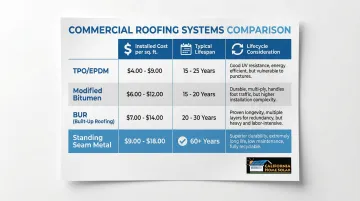
PACE financing programs available in California can reduce the barrier to higher-quality systems by spreading costs over time through property tax assessments — worth factoring into any lifecycle cost comparison.
Contractor Expertise and Warranty
Even the best-specified system underperforms with poor installation. Verify that your contractor is licensed, bonded, and experienced with the specific system being installed — not just roofing in general. Also clarify upfront what the manufacturer's warranty covers versus the contractor's workmanship warranty, since gaps between the two are a common source of disputes.
Common Mistakes to Avoid When Selecting a Commercial Roofing System
Choosing by Price Alone
Selecting the cheapest system without evaluating lifespan, maintenance costs, and climate suitability often results in higher total expenditure over time. A roof failure on a commercial property triggers costs well beyond the roofing budget — business interruption, inventory damage, and emergency repairs.
Ignoring California-Specific Compliance Requirements
Overlooking Title 24 cool roof standards or local building codes can result in failed inspections, required rework, and invalidated permits. Always confirm code compliance before finalizing a system — a quick check upfront saves costly rework later.
Selecting Based on Familiarity Rather Than Fit
A roofing system that performed well on a previous or nearby building may be wrong for a different roof slope, structural load, or use case. Each building warrants its own assessment — not a repeated spec from a previous job.
Conclusion
Commercial roofing systems vary significantly in material, performance, cost, and suitability. Choosing the wrong system for your building type or climate can mean premature failures, higher energy bills, and costly replacements within a decade.
In Southern California's climate, the right choice comes down to a few core factors:
- Energy efficiency and cool roof compliance — required under California's Title 24 standards
- Building structure — roof slope, load capacity, and existing insulation
- Budget and lifespan — upfront cost vs. long-term maintenance and replacement cycles
- Exposure conditions — UV intensity, coastal salt air, or fire-prone zones
The right system reduces operating costs and keeps your building protected for decades without unexpected repairs.
That's where hands-on expertise matters. CA Home Solar has been installing and assessing commercial roofing systems across the Los Angeles area for 36 years. Call 877-903-1012 or email info@cahomesolar.com to schedule a professional assessment and get a system recommendation matched to your building.
Frequently Asked Questions
What is the best commercial roofing system?
No single system fits every building. The right choice depends on roof pitch, climate, building use, and budget. For Southern California's hot, high-UV conditions, reflective systems like TPO or cool-coated metal are frequently recommended for their energy efficiency and Title 24 compliance.
What are the different types of commercial roofing systems?
The main types are TPO, EPDM, Modified Bitumen, Built-Up Roofing (BUR), and Metal. Each serves different building needs, with flat/low-slope roofs most commonly using membrane systems like TPO or EPDM, while sloped roofs can accommodate standing seam metal.
What is the 25% rule in roofing?
The 25% rule states that if more than 25% of a roof requires repair within a 12-month period, full replacement is typically recommended over continued patching. This provision was removed from the International Building Code in 2003, though local codes vary in how they apply similar thresholds.
How long do commercial roofing systems typically last?
Lifespans vary significantly by system type:
- EPDM: 25–35 years
- TPO: 20–30 years
- Modified Bitumen: 20–30 years
- BUR: 20–30 years
- Metal roofing: 60+ years
Actual lifespan depends on installation quality, maintenance frequency, and climate exposure.
Which commercial roofing system is most energy-efficient for Southern California?
TPO and light-colored metal roofing with high Solar Reflectance Index (SRI) ratings are among the most energy-efficient options for Southern California's climate. Both help reduce cooling loads and support California Title 24 compliance, with aged SRI ratings typically above 75 — a key Title 24 threshold.
How much does a commercial roofing system cost?
Costs vary by system type and roof size:
- TPO/EPDM: $8.00–$14.50 per sq. ft.
- Modified Bitumen: $12.50–$17.50 per sq. ft.
- BUR: $15.00–$22.00 per sq. ft.
- Standing seam metal: $12.00–$22.00+ per sq. ft.
PACE financing options like Ygrene and California First can help commercial property owners manage upfront costs.