Introduction
If you're a Southern California homeowner watching your utility bill climb month after month, you're not alone. With electricity rates rising and abundant sunshine year-round, solar is a natural choice for LA County and the Inland Empire. But here's where many property owners get stuck: should you mount panels on your roof or install them on the ground?
The answer affects more than aesthetics. Your choice shapes upfront costs, long-term energy output, usable yard space, and payback timeline. Those variables shift considerably based on your lot size, roof condition, and local regulations across Southern California.
This guide breaks down both options side-by-side — covering installation costs, efficiency, space requirements, and SoCal-specific permitting factors — so you know exactly which setup fits your property before you call a contractor.
TLDR
- Rooftop solar costs less upfront and works best for homes with south- or west-facing roofs free of heavy shading
- Ground mount solar runs roughly $8,800 more for a typical system, but it allows optimal panel positioning for properties with large open land
- NEM 3.0 has reduced export credits by ~75%, making panel output optimization more critical than ever
- California's Solar Rights Act protects rooftop installations from HOA bans, though ground mounts may face more scrutiny
- Your roof's condition, available yard space, and energy consumption all shape which option delivers the better return for your property
Ground Mount vs. Rooftop Solar: At a Glance
Here's a quick side-by-side across the five factors that matter most for Southern California homeowners.
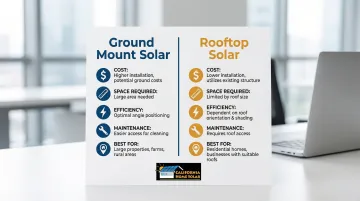
| Ground Mount | Rooftop | |
|---|---|---|
| Cost | ~$3.26/watt ($26,080 for 8 kW) — includes foundation, racking, and trenching | ~$2.38/watt ($19,040 for 8 kW) — uses existing roof structure |
| Space Required | 300–500 sq ft of open land; underground conduit run to main panel | No extra land; limited to usable roof area |
| Efficiency | Optimal tilt (30–34°) + airflow = 3–5% efficiency gain; tracking adds 15–25% | Output depends on existing pitch, orientation, and shading |
| Maintenance | Easy ground-level access — important in dusty areas like Palmdale or Antelope Valley | Requires climbing or equipment; harder to clean regularly |
| Best For | Large lots, north-facing or obstructed roofs, high energy demands | Suburban homes with south- or west-facing roofs and minimal shading (Burbank, Glendale, Torrance, Long Beach) |
What Is Rooftop Solar?
Rooftop solar consists of panels mounted directly onto your home's existing roof structure using rails and racking hardware, connected to the grid through an inverter. It's the dominant installation type in dense SoCal markets like Burbank, Glendale, and West Covina where lot sizes are limited and maximizing existing structures makes financial sense.
Core benefits tied to practical outcomes:
- No foundation or trenching required, keeping upfront costs lower
- Your yard stays fully usable — no land sacrificed to equipment
- Elevated panels are less exposed to wildlife and vandalism
- Rooftop installations typically move faster through local building departments
Key limitations to consider:
Roof pitch, age, and material all affect feasibility. A north-facing or heavily shaded roof — common in canyon communities like Topanga or hillside properties in Palos Verdes — can reduce production by 30% or more.
An aging roof may need replacement before or during installation, adding $15,000+ to your project cost. If your roof is nearing the end of its life, bundling solar with a new roof can consolidate the work and permitting into a single project.
When Does Rooftop Solar Make Sense in Southern California?
The ideal SoCal rooftop candidate has:
- South- or west-facing roof slope
- Minimal shade from trees or adjacent structures
- Roof in good condition (less than 10-15 years old)
- Moderate energy usage that fits within available roof space
Many tract homes in the San Fernando Valley, Long Beach, and Torrance fit this profile perfectly. If your roof needs replacement, contractors like CA Home Solar — which handles both solar and roofing — can bundle the work into a single installation, saving time and consolidating permits.
Legal protection for homeowners: California's Solar Rights Act (Civil Code §714) limits HOAs from outright banning rooftop solar. HOAs can impose aesthetic restrictions only if those restrictions don't increase costs by more than $1,000 or decrease efficiency by more than 10%. This gives SoCal homeowners strong legal protection when dealing with community associations.
What Is Ground Mount Solar?
Ground-mounted solar consists of freestanding panels installed on metal frames anchored into the ground via driven posts or concrete foundations. You can position the array anywhere on open property, making it a strong fit for SoCal homeowners with larger parcels—particularly in Palmdale, Lancaster, Agoura Hills, and Malibu.
Two Main Types
Standard Fixed-Tilt Ground Mounts: Panels are set at a fixed angle (typically 30-34 degrees for Southern California), with some systems allowing manual seasonal adjustment. The more affordable of the two options.
Pole-Mounted Systems with Tracking: Single-axis tracking boosts annual production by 15-25% over fixed-tilt arrays; dual-axis tracking can push that to 30-40%. For most residential installations, though, the added complexity and cost don't justify the output gains.
The Efficiency Advantage
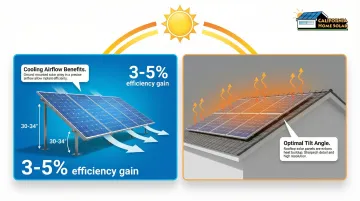
Because panels can be set to the optimal tilt angle for Southern California's latitude (approximately 34°N), ground mounts capture more direct sunlight year-round than a rooftop system constrained by existing roof pitch. That 30-34 degree sweet spot aligns precisely with SoCal's sun angle.
Ground-mounted systems also benefit from natural airflow underneath the panels, reducing operating temperatures and improving efficiency by 3-5% compared to roof-mounted arrays where heat builds up against the surface. These two factors combined—optimal tilt plus cooling airflow—are why ground mounts consistently outperform comparably sized rooftop systems in output per panel.
When Does Ground Mount Solar Make Sense in Southern California?
Ground mounts are the smart choice for specific SoCal property profiles:
Large or semi-rural lots: Properties in Antelope Valley, Claremont, San Dimas, or hillside estates with open south-facing slopes where you have 300-500+ square feet of unobstructed land.
Roof limitations: Homes where the roof is covered by mature trees, faces north, has too many obstructions (chimneys, skylights, vents), or simply lacks enough square footage to install the system size you need.
High energy demand: SoCal homeowners adding EVs, heat pumps, or ADUs often need larger systems than their roof can accommodate. Ground mounts offer scalable capacity without roof constraints.
Site considerations unique to SoCal:
Soil type and stability vary dramatically across LA County—from rocky hillsides to sandy desert soil in Lancaster to clay-heavy Valley floors. A soil or structural assessment is required before installation to determine the proper foundation design for your site.
In wildfire-prone areas, ground-level electrical conduit must be buried 18-24 inches deep and maintain proper clearance from vegetation per LA County fire code requirements.
Ground Mount vs. Rooftop Solar: Which Is Right for Your Southern California Property?
Your decision hinges on four questions:
- What does my roof look like? Consider age, orientation, and shading
- How much open land do I have that gets unobstructed sun?
- What is my monthly energy consumption and future energy goal? (EV charging, ADU, pool heating)
- What is my budget and desired payback timeline?
The SoCal-Specific Cost Equation Under NEM 3.0
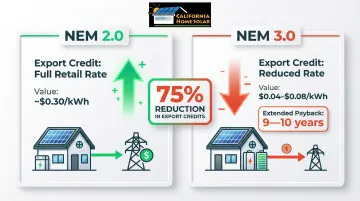
California's NEM 3.0 policy (effective April 2023) reshaped solar economics. Export credits dropped by approximately 75%—from full retail rates to just $0.04-$0.08 per kWh during typical daylight hours. This extends payback periods to 9-10 years and makes self-consumption efficiency critical.
Ground mounts angled at 30-34 degrees can generate more kilowatt-hours per panel than a roof constrained to a 20-degree pitch or east-west orientation. That production advantage matters more now: every extra kWh you generate and consume directly offsets a retail-rate bill, rather than feeding the grid at $0.04-$0.08.
Situational Recommendations
Choose rooftop solar if:
- Your roof faces south or west
- It's less than 10-15 years old
- Minimal shading exists
- Your energy usage is moderate (under 1,000 kWh/month)
Choose ground mount if:
- Your roof is poorly positioned, shaded, or too small
- You have open land on your property (300+ sq ft)
- You're adding high-demand loads (EV, ADU, pool)
- Your roof needs replacement soon and you'd rather avoid that complication
HOA and Permit Realities
Most SoCal homeowners in master-planned communities (Santa Clarita, Valencia, Westlake Village) have HOA oversight. While California law protects rooftop solar rights, ground-mounted systems in front or side yards may face more HOA pushback. Review your CC&Rs and consult your installer before proceeding.
Both systems require permits through local building departments (LADBS for City of LA, County Public Works for unincorporated areas), but ground mounts typically involve additional permits for grading or foundation work, especially on sloped terrain.
Real-World Scenarios
The regulations and checklists above only take you so far. Here's how those factors play out in practice.
Palmdale Homeowner (Ground Mount): A family with a north-facing roof and a half-acre lot installed a 10 kW ground mount at 32-degree south-facing tilt.
- Annual production: ~8,850 kWh
- System cost: $32,600 (vs. $23,800 rooftop estimate)
- Why it worked: A 9% production edge plus avoiding an $18,000 roof replacement made the higher upfront cost the right call.
Burbank Homeowner (Rooftop): A family with a south-facing roof in good condition installed an 8 kW rooftop system at $19,040.
- Annual production: ~8,100 kWh
- Payback period: 9 years
- Why it worked: Lower upfront cost, no land sacrifice, and straightforward permitting — no complications, no tradeoffs.
Conclusion
For most SoCal suburban homeowners, rooftop solar is the practical starting point — lower cost, faster installation, and no yard space required. Ground mount becomes the smarter long-term investment when roof limitations, shading, or high energy demands are in play.
The right choice comes down to your property conditions, energy goals, and budget. A local installer who knows Southern California's permit landscape, HOA rules, and utility regulations will save you time and costly surprises.
With 36 years serving LA County, CA Home Solar recommends the right system type for each property — whether rooftop, ground mount, or a combined solar-plus-roofing package.
Contact CA Home Solar at 877-903-1012 for a free property assessment. Their team will review your roof condition, energy usage, and available land to recommend the most cost-effective system for your home.
Frequently Asked Questions
Is ground-mounted solar cheaper than rooftop solar in California?
No, ground-mounted solar typically costs more: roughly $0.88 per watt, or $8,800 more for a 10 kW system. The premium comes from foundation work, racking, and trenching. That said, the long-term energy production advantage can offset the higher upfront cost, especially on properties where roof orientation limits panel performance.
Is ground-mounted or rooftop solar better in California?
Neither is universally better. Rooftop is more cost-efficient for most homes with good roof orientation and condition. Ground mount is better when roof space is limited, poorly oriented, or when high energy demands require a larger system than your roof can support.
What is the best angle for solar panels in Southern California?
Southern California sits around 34°N latitude, making a tilt angle of roughly 30-34 degrees ideal for maximum annual energy production. Ground mounts can be set to this optimal angle, while rooftop systems are constrained by existing roof pitch.
What is the best mounting system for solar panels?
Rail-based racking is the standard choice for rooftop installations and holds up well over time. On the ground, fixed-tilt mounts offer the best value, while pole mounts with single-axis tracking push production up by 15-25% at a higher cost.
Can I install ground-mounted solar if I have an HOA in Southern California?
California's Solar Rights Act strongly protects rooftop solar from HOA bans, but ground-mounted systems in visible yard areas may face more restrictions. Review your CC&Rs and consult your installer: HOAs can only impose restrictions that don't increase your costs by more than $1,000 or reduce system efficiency by more than 10%.
Do I need a permit for ground-mounted solar panels in Los Angeles?
Yes, permits are required for ground-mounted solar in LA County, typically including building and electrical permits. On sloped terrain or with significant excavation, grading permits may also be needed. Working with an experienced local installer simplifies this process.