Introduction
Southern California homeowners who invested in solar panels often assume they're covered during power outages. A PSPS event changes that assumption fast. When Southern California Edison (SCE) deliberately shuts off power to prevent wildfires, even homes with rooftop solar arrays go completely dark. This jarring reality catches many LA-area residents off guard, especially those in fire-prone communities like Malibu, Topanga, Altadena, and the Santa Clarita foothills.
The misconception is understandable: panels sit on your roof generating electricity in bright sunlight, yet your refrigerator stops running and your lights won't turn on. The reason lies in how grid-tied solar systems are designed and the safety regulations that require it.
Understanding why this happens — and what to do about it — starts with knowing how these systems work. This guide covers what PSPS events are, why your solar panels automatically shut off when the grid goes down, and what options exist to keep your home powered, including battery backup systems, inverter upgrades, and California incentives that can offset the cost.
What Is a PSPS and Why Do California Utilities Shut Off Power?
Understanding Public Safety Power Shutoffs
A Public Safety Power Shutoff (PSPS) is a deliberate step where utilities temporarily cut power to specific areas to reduce the risk of fires caused by electrical infrastructure. When dangerous fire weather conditions arise—strong winds, dry vegetation, and low humidity—Southern California Edison de-energizes circuits to prevent electrical equipment from igniting wildfires.
Key triggers for PSPS events include:
- Sustained winds exceeding 25 mph with gusts above 45 mph
- Humidity levels dropping below 20%
- Critically dry vegetation and high fire danger indices
- Red Flag Warnings issued by the National Weather Service
SCE monitors weather forecasts continuously and activates PSPS protocols when conditions cross risk thresholds in High Fire Threat Districts (HFTD). These shutoffs typically last 24 hours to several days, depending on how long conditions remain dangerous and how long it takes crews to safely inspect and re-energize lines.
Which LA County Areas Are Most Affected?
Much of Los Angeles County falls into HFTD Tier 2 (elevated risk) or Tier 3 (extreme risk) zones. If you live in any of these communities, your home is likely in PSPS territory:
- Malibu and Topanga – coastal mountain areas with significant wildfire exposure
- Altadena, La Cañada Flintridge, and Sierra Madre – foothill communities with dry brush
- Santa Clarita, Valencia, Canyon Country – communities in fire-prone canyons
- Lancaster and Palmdale – Antelope Valley high-desert areas
- Calabasas, Agoura Hills, Westlake Village – hillside neighborhoods
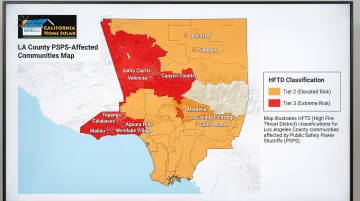
You can verify your specific address using the CPUC's official Fire Map.
Real-World Scale of PSPS Events
PSPS events can affect thousands of customers when activated. During a November 2024 high-threat event, SCE issued de-energization notices to customers in Los Angeles County — though favorable weather shifts ultimately prevented the shutoff from going forward.
The CPUC's Public PSPS Dashboard tracks post-event data going back to 2018, so you can check whether your address has been affected in the past.
Why Your Solar Panels Go Dark During a PSPS Outage
The Core Reason: Anti-Islanding Protection
Most residential solar systems are grid-tied, meaning they're designed to sync with and feed power into the utility grid. When the grid goes down—even intentionally during a PSPS—the system's inverter automatically shuts off within two seconds. This isn't a flaw; it's a required safety feature called anti-islanding protection.
If grid-tied solar continued to send electricity into de-energized power lines, it would create a lethal electrocution hazard for utility repair crews and first responders working to restore power. This automatic shutoff is mandated by IEEE 1547 (Standard for Interconnection and Interoperability of Distributed Energy Resources) and California's Electric Rule 21.
What Homeowners Actually Experience
Your panels may be sitting in full sunlight on your roof, but your home has no power. The inverter shutdown happens regardless of weather—and it catches most homeowners off guard, since solar feels like a backup until the moment it isn't.
The reality:
- Lights won't turn on
- Refrigerator stops running
- Wi-Fi and phone chargers are dead
- Medical devices lose power
- Your solar monitoring app shows zero production
Grid-Tied vs. Other System Types
That bullet list above isn't a worst-case scenario—it's the default for most installed systems. A standard grid-tied inverter has no backup capability on its own. Without battery storage or a hybrid inverter, your system provides zero power during a PSPS, regardless of how sunny it is outside.
Limited Partial-Power Options:
Some newer inverters offer limited daytime-only power to a single outlet even without a battery:
- Enphase Sunlight Backup (IQ8 Series): Powers low-load appliances during daytime outages using microinverters, but only when the sun is shining and loads don't exceed production
- SMA Secure Power Supply: Provides up to 1,920W to a dedicated outlet, but requires manual activation and is strictly limited to solar production availability
These options provide nothing after dark, cut out when clouds pass, and can't support medical equipment or whole-home loads. If reliable backup power matters to you, battery storage is the only real answer.
Your Options for Staying Powered During a PSPS
Solar + Battery Storage (The Most Effective Solution)
Adding a battery backup system transforms your solar installation into a "solar island." When the grid goes down, the battery disconnects automatically—typically within milliseconds. Your solar panels then recharge the battery throughout the day, extending backup power as long as the sun shines.
How it works:
- Grid goes offline (PSPS event begins)
- Battery system detects outage and disconnects from grid
- Battery begins powering your home's essential circuits
- Solar panels recharge battery during daylight hours
- System provides continuous power until grid restoration
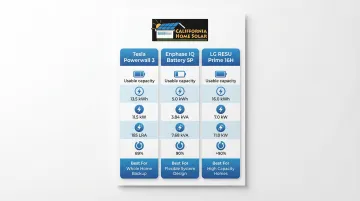
Leading battery systems include:
| Battery Model | Usable Capacity | Continuous Power | Peak Power | Efficiency |
|---|---|---|---|---|
| Tesla Powerwall 3 | 13.5 kWh | 11.5 kW | 185 LRA | 89% |
| Enphase IQ Battery 5P | 5.0 kWh | 3.84 kVA | 7.68 kVA | 90% |
| LG RESU Prime 16H | 16.0 kWh | 7.0 kW | 11.0 kW | >90% |
Cost Context:
Battery storage systems in California average $1,031 per kWh installed, with total system costs ranging from $11,392 to $15,412 for a typical 13 kWh system. Final pricing depends on battery capacity, number of units, electrical panel upgrades, and home size.
CA Home Solar has been helping Southern California homeowners design and install solar + battery systems for 36 years, and can assess whether your existing system can be retrofitted with battery storage or requires a new setup.
Inverter Upgrade Without Battery (Limited Backup Option)
Some homeowners can replace their existing inverter with a hybrid or backup-capable inverter that provides limited daytime-only power to a designated circuit even without a battery—at a lower upfront cost of approximately $1,000–$2,500.
Significant limitations include:
- No power at night
- Output drops when clouds pass over panels
- Not reliable enough for medical equipment
- Can only support a fraction of normal home load
- May require manual activation
This option works for minor outages, but it won't carry a household through a multi-day PSPS event — which is exactly where generators come in as the other traditional fallback.
Generators (The Traditional Alternative)
Portable generators can work during PSPS events, but come with meaningful drawbacks:
Disadvantages:
- Requires stored gasoline or propane — supply runs short fast during regional emergencies
- Causes roughly 92 CO poisoning deaths per year when misused
- Generates noise disruptive enough to strain neighbor relations during extended outages
- Faces a hard deadline: CARB mandates zero-emission portable generators by 2028
- Requires manual startup and cannot recharge on its own
Generators must be placed at least 20 feet away from your home with exhaust directed away from windows and doors. Never operate a generator inside a home, garage, or basement.
How Long Will Battery Backup Power Your Home During a PSPS?
During a PSPS, how long your battery keeps the lights on comes down to three things:
Key Variables That Determine Duration
- Battery capacity (measured in kWh)
- Power draw of the appliances being run
- Solar recharging during daylight hours
Practical Reference Points
A single-battery system (such as a Powerwall at ~13.5 kWh) typically powers essential appliances—refrigerator, lighting, a few outlets—for 24–48 hours without solar recharging. With solar recharging, it can extend indefinitely during multi-day PSPS events.
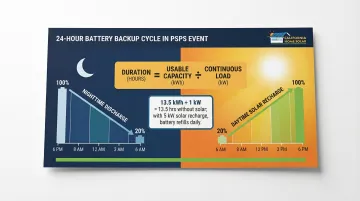
The formula: Duration (Hours) ≈ Usable Battery Capacity (kWh) ÷ Continuous Load (kW)
Example: A 13.5 kWh Powerwall powering a 1 kW continuous load (fridge + lights + router) would last about 13.5 hours without solar. With solar panels generating 5 kW during peak hours, the battery recharges fully each day, providing continuous power throughout a multi-day PSPS.
Load Prioritization Strategy
Homeowners should identify their critical loads in advance:
Keep running:
- Refrigerator and freezer
- Medical devices and CPAP machines
- Phone chargers and Wi-Fi router
- A few LED lights
- Laptop or tablet
Shut off to extend runtime:
- Electric dryer
- EV charger
- Air conditioning
- Pool pumps
- Electric water heater
By isolating essential loads, a single battery can stretch backup duration significantly during extended PSPS events.
California Financial Incentives for Adding Battery Backup
Self-Generation Incentive Program (SGIP)
California's SGIP provides substantial rebates to homeowners who install battery storage. SCE customers in Southern California can access SGIP rebates with tiered incentive structures:
Current SGIP rates:
- General Market (Step 7): $0.15/Wh
- Residential Storage Equity: $0.85/Wh for low-income customers
- Equity Resiliency Budget: $1.00/Wh for vulnerable households in high fire-threat zones
Equity Resiliency eligibility requires:
- Location in Tier 2 or Tier 3 HFTD OR experiencing two or more PSPS events
- Meeting vulnerability criteria (Medical Baseline enrollment, electric well pump reliance, etc.)
For a 13.5 kWh Powerwall, the Equity Resiliency rebate would provide $13,500—potentially covering nearly the entire cost of the battery system.
These state rebates can also be stacked with federal incentives, which brings the total savings even higher.
Federal Investment Tax Credit (ITC)
Under the Inflation Reduction Act, residential battery storage systems (≥3 kWh) qualify for a **30% federal tax credit**. Batteries do not need to be charged by solar to qualify. Standalone storage installed after 2023 is eligible.
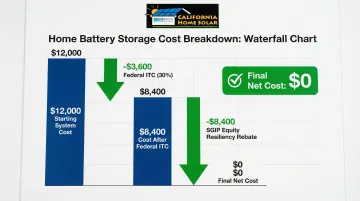
Example calculation:
- Battery system cost: $12,000
- Federal ITC (30%): -$3,600
- SGIP rebate (Equity tier): -$13,500
- Net cost: $0 (fully covered by incentives)
HERO Financing Program Status
CA Home Solar is a HERO Registered Contractor. However, California regulators have issued a two-year freeze on new PACE applications as of late 2025/early 2026, halting this financing option for the near term. Contact CA Home Solar directly to discuss current financing alternatives for battery backup installations.
How Southern California Homeowners Should Prepare Before the Next PSPS
Check Your Fire-Risk Zone
Verify your address on the CPUC's High Fire Threat District map to understand your risk level and likelihood of being included in future PSPS events. Knowing your HFTD tier (2 or 3) also determines your eligibility for enhanced SGIP rebates.
Know Your System's Capabilities Now
Contact your solar installer or a licensed contractor to confirm exactly what your current system can and cannot do during a grid outage. Do not assume battery backup is included—most standard grid-tied systems provide zero power during outages.
CA Home Solar provides system assessments for LA County homeowners, including evaluations of whether your existing setup can be retrofitted with battery storage or requires a new configuration. Once you know what your system can do, you can build a response plan around it.
Create a PSPS Emergency Plan
Before a PSPS event:
- Charge all devices and EVs as soon as a PSPS warning is issued
- Identify which appliances are essential
- Store food-safe supplies and ice
- Fill bathtubs with water for flushing toilets
- Locate flashlights and battery-powered radios
For medical equipment users:
- Register with SCE's Medical Baseline or Life Support program to receive advance PSPS notifications
- SCE provides an additional 16.5 kWh per day at the lowest baseline rate to offset equipment costs
- Eligible customers in high fire-risk areas may qualify for a free portable backup battery and solar panel
Apply at sce.com/mbl
Sign Up for Outage Alerts
Non-account holders (tenants, caregivers) can sign up for PSPS alerts at scepsps.com. Account holders should register at sce.com/outages-safety/outage-center/get-alerts to receive email, text, or voice notifications.
Frequently Asked Questions
How to use solar panels during power outage in California?
Standard grid-tied solar panels do not power a home during an outage due to mandatory anti-islanding safety shutoffs. Adding a battery storage system allows your solar panels to charge the battery and power your home even when the grid is down.
What is PG&E PSPS?
PSPS (Public Safety Power Shutoff) is a planned power shutoff by utilities like PG&E or SCE during high fire-risk weather to prevent electrical lines from igniting wildfires. Southern California homeowners are subject to SCE's equivalent PSPS program.
Why are they shutting off power in California?
Utilities shut off power during high-wind, low-humidity conditions because energized power lines passing through fire-prone terrain can spark wildfires. Past disasters confirm the risk — utility equipment ignited the Camp Fire and several other devastating wildfires across California.
What is the major disadvantage of a grid-tie inverter?
The primary disadvantage is that grid-tied inverters automatically shut down when the utility grid goes offline, meaning your solar panels provide zero power to your home during any outage—including PSPS events—unless a battery or hybrid inverter is also installed.
How long do solar PV batteries last?
Battery lifespan typically ranges 10–15 years before significant capacity degradation. During an outage, a single battery typically covers essential loads for 24–48 hours, with solar panels recharging it during daylight for extended backup.
Is SGIP worth it?
SGIP rebates can significantly reduce battery storage costs for California homeowners, especially those in high fire-threat areas who may qualify for equity tier rebates of $0.85–$1.00/Wh. When stacked with the 30% federal ITC, many Southern California homeowners bring their net battery cost close to zero.